
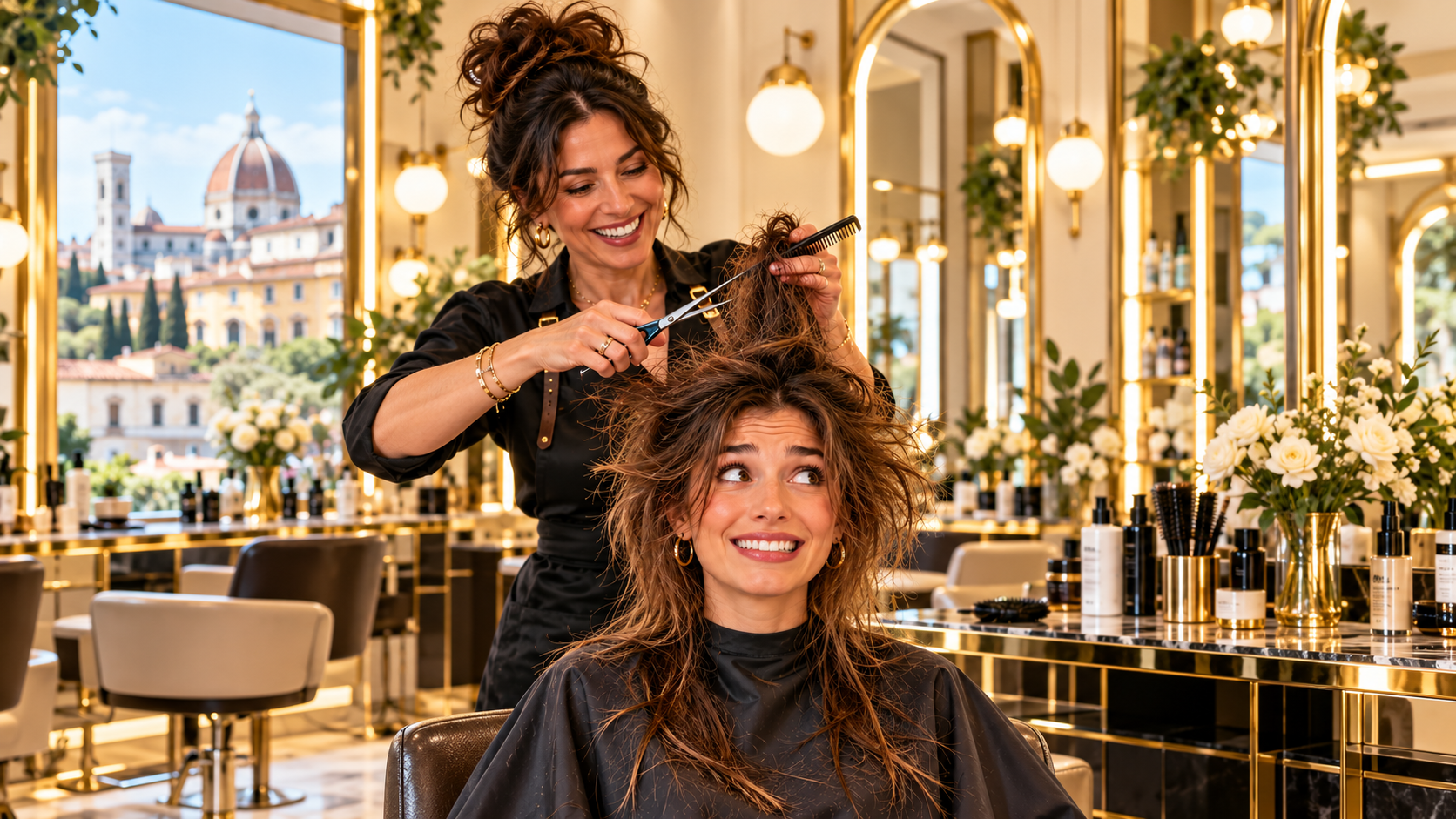
Getting a haircut in another country can be a surprisingly stressful experience.
You may know exactly what you want, but explaining it in another language is a different story.
Fortunately, you do not need complicated Italian to handle a visit to a hair salon. A few useful phrases can take you through everything from arriving for your appointment to explaining the style you want.
Let’s start with one of the most common situations: arriving at the salon.
You might say:
Buongiorno. Ho un appuntamento alle undici per un taglio.
Good morning. I have an appointment at eleven for a haircut.
The receptionist may confirm your name and the person you are seeing:
Signora Anna, vero?
Ms Anna, right?
Ha un appuntamento con Francesca.
You have an appointment with Francesca.
And then you may hear:
Può accomodarsi.
You can take a seat.
This last expression is particularly useful because you will hear accomodarsi in many situations in Italy—not only at a hair salon, but also in restaurants, offices, hotels and waiting rooms.
Useful Italian Phrases at the Hair Salon
Once you are in the chair, the conversation becomes a little more specific.
Here are some phrases worth knowing:
Vorrei tagliare i capelli.
I would like to have my hair cut.
Vorrei solo una spuntatina.
I would just like a trim.
Non troppo corti, per favore.
Not too short, please.
Solo le punte.
Just the ends.
Vorrei accorciarli un po'.
I would like to shorten them a little.
Vorrei fare il colore.
I would like to have my hair colored.
Vorrei fare dei colpi di sole.
I would like to get highlights.
Vorrei una piega liscia.
I would like a straight blow-dry.
Vorrei una piega mossa.
I would like a wavy blow-dry.
Come mi stanno?
How do they look on me?
Mi piace molto.
I really like it.
And one phrase that may save you from an unwanted haircut:
Solo un centimetro, per favore.
Only one centimeter, please.
Sometimes numbers are more effective than adjectives.
Parrucchiere or Salone?
You will hear several words used when talking about hair salons in Italy.
Il parrucchiere can refer to the hairdresser, but Italians also commonly use expressions such as:
Vado dal parrucchiere.
I'm going to the hairdresser.
A female hairdresser is la parrucchiera.
You may also see businesses described as a salone, salone di parrucchiere, or hair salon, particularly in larger cities and more modern establishments.
What Does “Piega” Mean?
This is one of those useful Italian words that can confuse visitors.
In a hair salon, la piega generally refers to styling the hair, especially styling with a hairdryer and brush after washing it.
Treccani defines messa in piega as a form of acconciatura or pettinatura—in other words, hairstyling.
So if someone asks:
Che tipo di piega preferisce?
they are essentially asking:
How would you like your hair styled?
You might answer:
Una piega naturale.
A natural blow-dry/style.
or:
Una piega liscia.
A straight blow-dry.
This is a useful term to remember because piega may appear separately on a salon's price list.
A Few Tips for Visiting a Hair Salon in Italy
If you are visiting a new salon, booking ahead is a good idea, particularly for busy salons or popular times such as Saturdays. Italian salon guides commonly recommend confirming the day, time and stylist rather than relying on simply walking in.
It is also perfectly normal—and often much easier—to show your hairdresser a photograph of the style you want. This can be especially helpful when your Italian is limited. Salon guidance in Italy specifically recommends bringing a visual reference instead of relying on a vague description.
Another useful tip is to ask what is included in the price.
A taglio, shampoo, piega, color treatment or other treatment may be listed separately depending on the salon. Italian salon pricing guides advise customers to clarify what is included before the service begins, because a blow-dry or special treatment may be an additional charge.
You can simply ask:
Quanto costa il taglio?
How much does the haircut cost?
Or:
La piega è inclusa?
Is the blow-dry included?
Do You Tip Your Hairdresser in Italy?
If you are coming from a country where tipping hairdressers is expected, Italy may be different.
Tipping a hairdresser is generally optional rather than obligatory. Leaving a few euros when you are particularly happy with the service is certainly appreciated, but it is not normally treated as something you must do.
So you do not need to worry about calculating a mandatory percentage every time you visit a salon.
An Interesting Italian Hair-Salon Fact
Here is something many Italian learners do not realize:
The word piega literally has meanings connected to a fold, bend or the direction something takes.
It can even describe the direction in which hair naturally falls. Treccani includes the sense of the direction or shape taken by the hair among the meanings of piega.
That helps explain why Italians use fare la piega for styling hair.
It is not literally saying “do a blow-dry.”
The idea is closer to giving the hair its shape.
That is a good example of why learning real everyday Italian is often more useful than translating English word for word.
Before You Go
A trip to the hair salon is also a great opportunity to practice Italian because the conversations tend to follow a predictable pattern.
You arrive.
You confirm your appointment.
You explain what you would like.
The hairdresser asks a few questions.
And eventually, hopefully, you say:
Perfetto. Mi piace molto!
Perfect. I really like it!
Learning just a handful of expressions before your appointment can make the entire experience much easier—and a lot more enjoyable.
I deliberately kept this in the PC style: practical Italian first, but with enough cultural information that someone could read it even if they weren’t actively studying the language.
Free Italian PDFs
Want to practice before your next trip?
We also have FREE Italian PDFs covering restaurants, hotels, travel situations, everyday conversations and useful vocabulary.
———CLICK HERE FOR THE FREE PDFs———
You don’t need perfect Italian to enjoy a restaurant in Italy.
You just need enough to follow the evening.
And enough to know what to say when it’s your turn.
CONTINUE LEARNING ITALIAN FOR TRAVEL