
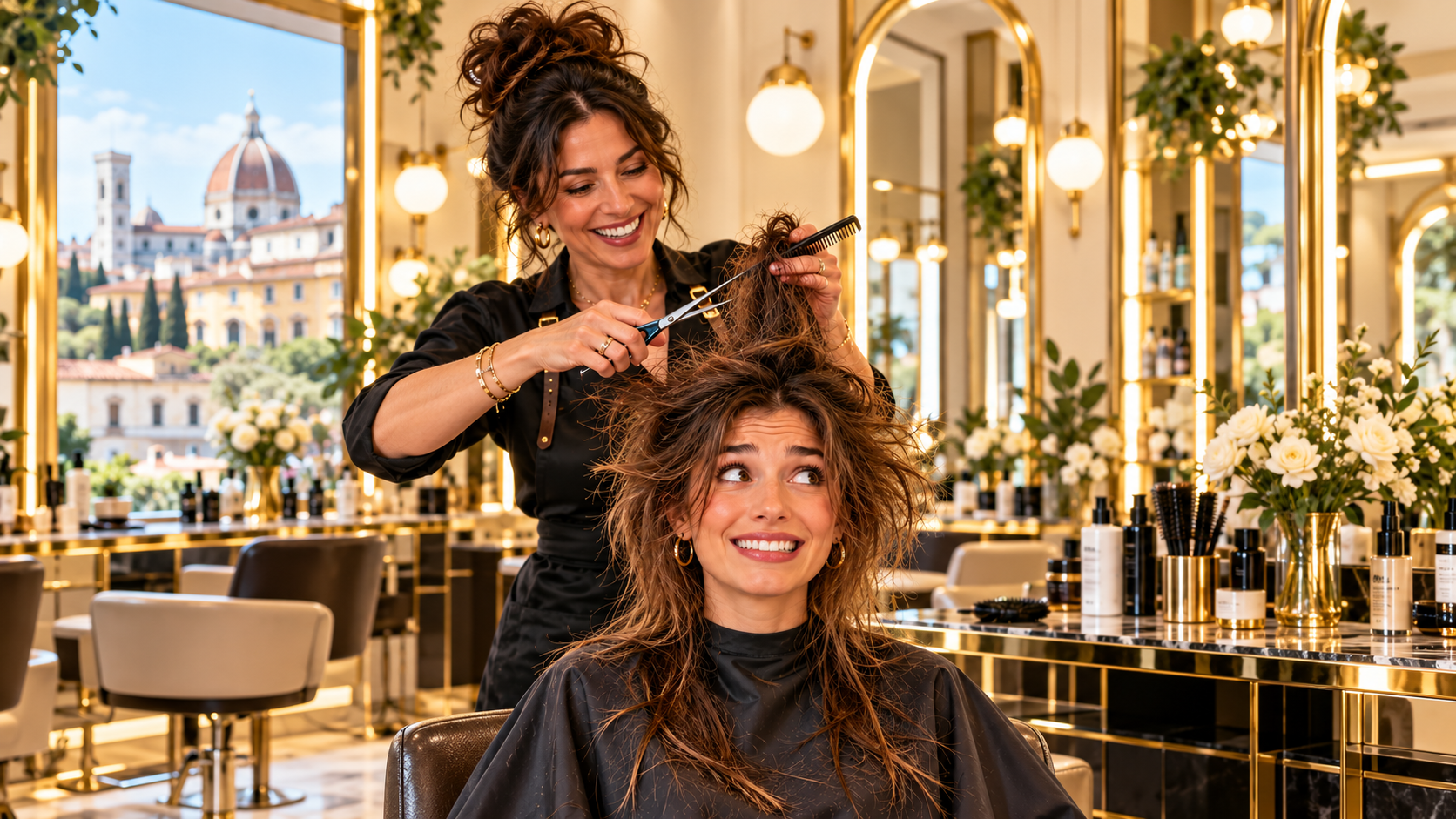
Visiting a hair salon in Italy does not have to be stressful. Learn useful Italian phrases for booking, explaining the haircut or style you want, asking about prices, and understanding common salon vocabulary such as piega.

ITALIAN IN REAL LIFE
This useful hotel phrase helps travelers explain that the air conditioning isn’t working and get assistance during their stay in Italy.
“C’è un problema con l’aria condizionata” in Italian.
There is a problem with air conditioning.
The Italian expression avere fretta means “to be in a hurry.”
It is a very common everyday expression used when you do not have much time or need to move quickly.
Example:
“Scusa, ho fretta.”
Sorry, I’m in a hurry.
Another example:
“Abbiamo fretta.”
We’re in a hurry.
You may hear this expression while traveling, commuting, shopping, or during busy daily situations.
Learn practical Italian expressions and how Italians naturally speak in everyday life.
Italian Idioms #12: Essere A Pezzi
The Italian expression essere a pezzi literally translates to “to be in pieces,” but Italians use it to mean being exhausted, extremely tired, or worn out.
You may hear this phrase after work, travel, studying, or any busy day.
“Dopo il lavoro sono a pezzi.”
After work I’m exhausted.
In this lesson, practice pronunciation and learn how Italians naturally use this common expression.
The Italian expression prendere in giro means “to make fun of someone” or “to tease someone.”
It is a common expression used in everyday Italian conversations.
“Mi stai prendendo in giro?”
Are you making fun of me?
You may hear this phrase among friends, family members, or in playful conversations.
Learn real Italian expressions and idioms used by native speakers.
You’re in Italy. Someone starts speaking… and you don’t understand.
Don’t panic. One simple phrase can help.
“Mi dispiace… non capisco.”
I’m sorry… I don’t understand.
This phrase is useful when speaking with locals, asking questions, shopping, traveling, or navigating everyday situations.
Learn practical Italian for real-life conversations and travel.
The Italian expression avere un diavolo per capello literally means “to have a devil on every hair,” but Italians use it to describe someone who is extremely angry, irritated, or in a terrible mood.
You may hear this expression when someone is very upset or frustrated.
“Oggi ha un diavolo per capello.”
Today he is in a really bad mood.
Learn common Italian idioms and how Italians naturally use them in everyday conversation.
The Italian expression avere la testa fra le nuvole literally means “to have your head in the clouds.”
It is used when someone is dreaming, distracted, absent-minded, or not paying attention.
You may hear this expression when someone seems lost in thought or not focused.
“Oggi hai la testa fra le nuvole.”
Today you have your head in the clouds.
Learn common Italian idioms and discover how Italians naturally use them in everyday conversation.
The Italian expression avere le mani bucate literally means “to have holes in your hands,” but Italians use it to describe someone who spends money very easily or cannot save.
It is often used for people who buy things quickly or have difficulty keeping money.
“Lui ha le mani bucate.”
He spends money very easily.
Learn common Italian idioms and how Italians naturally use them in everyday life.
The Italian expression essere nei guai means “to be in trouble” or to be in a difficult situation.
It is used when someone has problems, made a mistake, or finds themselves in a complicated situation.
You may hear this expression in everyday conversations, at work, at school, or while talking about life problems.
Example:
“Sono nei guai.”
I’m in trouble.
Learn common Italian expressions and discover how Italians naturally speak in real life situations.
The Italian expression andare piano literally means “to go slowly,” but Italians also use it to mean “take it easy,” “slow down,” or “be careful.”
You may hear this expression when driving, walking, learning, or when someone wants you to calm down and not rush.
Example:
“Vai piano!”
Slow down!
Another example:
“Parla piano.”
Speak slowly.
Learn practical Italian expressions and how Italians naturally speak in everyday life.
The Italian expression fare una figuraccia means “to embarrass yourself” or “make a bad impression.”
Italians use this expression when something awkward, embarrassing, or uncomfortable happens.
Example:
“Ho fatto una figuraccia.”
I embarrassed myself.
Another example:
“Non voglio fare una figuraccia.”
I don’t want to make a fool of myself.
You may hear this expression before meetings, presentations, social situations, or whenever someone feels nervous about making mistakes.
Learn practical Italian expressions and how Italians naturally speak in everyday life.
The Italian expression essere al settimo cielo literally means “to be in the seventh heaven,” but Italians use it to mean being extremely happy, excited, or overjoyed.
In English, it is similar to saying:
“I’m over the moon.”
or
“I’m on cloud nine.”
Example:
“Sono al settimo cielo!”
I’m over the moon!
You may hear this expression after good news, achievements, celebrations, travel, relationships, or special life moments.
Learn practical Italian expressions and how Italians naturally speak in everyday life.
The Italian expression che cavolo! is a mild and common way to show surprise, annoyance, frustration, or disbelief.
Literally, it means “what cabbage,” but Italians use it similarly to saying:
“What the heck?”
or
“What on earth?”
Example:
“Che cavolo stai facendo?”
What the heck are you doing?
It is softer and more polite than stronger expressions and is often used in everyday conversations.
Learn practical Italian expressions and how Italians naturally speak in real life.
The Italian expression non vedo l’ora literally means “I can’t see the hour,” but Italians use it to say:
“I can’t wait.”
It is used when you are excited, happy, or looking forward to something.
Example:
“Non vedo l’ora di vederti.”
I can’t wait to see you.
You may hear this expression before trips, holidays, celebrations, meetings, or exciting events.
Learn practical Italian expressions and how Italians naturally speak in everyday life.
The Italian expression in bocca al lupo literally means “into the wolf’s mouth,” but Italians use it to wish someone good luck.
It is commonly used before:
Exams
Interviews
Trips
Presentations
Important events
Example:
“Domani ho un esame.”
Tomorrow I have an exam.
“In bocca al lupo!”
Good luck!
Traditional response:
“Crepi il lupo!”
May the wolf die!
Today, many people also simply reply:
“Grazie!”
Learn practical Italian expressions and how Italians naturally speak in everyday life.
Family is one of the most important parts of Italian culture, so learning how to talk about family in Italian is incredibly useful for real-life conversations.
In this lesson, you will learn essential Italian family vocabulary along with useful phrases Italians use naturally in everyday situations.
Some of the basic vocabulary includes:
la famiglia — the family
la madre — the mother
il padre — the father
il fratello — the brother
la sorella — the sister
il figlio — the son
la figlia — the daughter
il nonno — the grandfather
la nonna — the grandmother
lo zio — the uncle
la zia — the aunt
il cugino / la cugina — cousin
la moglie — wife
il marito — husband
You will also hear useful example phrases like:
“Ti presento la mia famiglia.”
I introduce you to my family.
“Questo è mio padre.”
This is my father.
“Questa è mia madre.”
This is my mother.
“Loro sono i miei genitori.”
They are my parents.
Learning family vocabulary is a great way to improve your Italian conversation skills and speak more naturally in Italy.
Whether you are traveling, meeting Italian friends, or simply learning the language for fun, these are words you will hear often in everyday life.
Traveling in Italy is an amazing experience, but sometimes unexpected problems happen. You might lose your luggage, miss a train, lose your passport, or need help finding transportation.
In this lesson, you’ll learn useful Italian phrases for handling common travel problems and difficult situations with more confidence.
Some of the practical phrases included in this lesson are:
Non trovo il mio bagaglio. Può controllare nel sistema?
(I can’t find my luggage. Can you check the system?)
Ho perso il mio passaporto.
(I lost my passport.)
Ho lasciato il mio portafoglio al ristorante. Potete controllare per favore?
(I left my wallet at the restaurant. Can you check, please?)
Mi scusi, ho perso il treno. Qual è il prossimo?
(Excuse me, I missed the train. When is the next one?)
Il mio volo è stato cancellato. Cosa posso fare?
(My flight was canceled. What can I do?)
Quanto costa un taxi per andare in centro?
(How much is a taxi to the city center?)
Dove si trova la fermata dell’autobus?
(Where is the bus stop?)
These are real-world Italian phrases that can help you stay calm and communicate more effectively during stressful situations while traveling in Italy.
Whether you are visiting Italy for vacation, studying Italian, or preparing for everyday travel conversations, these expressions are extremely useful to know.
Small talk is an important part of Italian culture. Whether you are sitting in a café, meeting new people, traveling through Italy, or having a casual conversation, knowing a few natural Italian phrases can help you feel more confident and connected.
In this lesson, you’ll learn useful Italian expressions for asking questions, starting conversations, and giving compliments in everyday situations.
Some of the phrases included in this lesson are:
Di dove sei?
(Where are you from?)
Ti piace vivere qui?
(Do you like living here?)
Qual è il tuo hobby preferito?
(What’s your favorite hobby?)
Cosa fai di bello?
(What do you do for a living?)
Da quanto tempo vivi in questa città?
(How long have you been living in this city?)
Che bel vestito!
(What a beautiful dress!)
Mi piace molto il tuo sorriso.
(I really like your smile.)
Lei è molto gentile!
(You are very kind!)
Stai benissimo con questo vestito.
(You look amazing in this dress.)
These are natural Italian phrases that can help you sound more relaxed, friendly, and conversational while speaking with native Italians.
Perfect for beginners, travelers, and anyone who wants to improve their real-world Italian conversation skills.
Italy is full of beautiful cities, charming villages, historic buildings, beaches, mountains, and unforgettable landscapes. In this lesson, you’ll learn useful Italian vocabulary and adjectives for describing places naturally and confidently.
You’ll also learn important grammar rules for using adjectives correctly in Italian conversation.
Some of the vocabulary and examples included in this lesson are:
Italian adjectives usually agree with the noun in gender and number.
Examples:
Una città bella
(A beautiful city)
Paesaggi belli
(Beautiful landscapes)
Adjectives usually come after the noun in Italian.
Examples:
Una spiaggia bella
(A beautiful beach)
Un edificio moderno
(A modern building)
Bello/a — Beautiful
Antico/a — Ancient
Moderno/a — Modern
Tranquillo/a — Peaceful
Vivace — Lively
Incantevole — Enchanting
Pittoresco — Picturesque
Fascinoso — Fascinating
Maestoso — Majestic
Caotico — Chaotic
Rilassante — Relaxing
Affollato — Crowded
Luminoso — Bright
Rustico — Rustic
Piacevole — Enjoyable
This lesson is perfect for beginners, travelers, and anyone who wants to speak more naturally when talking about Italy, travel, cities, beaches, restaurants, neighborhoods, and everyday experiences.