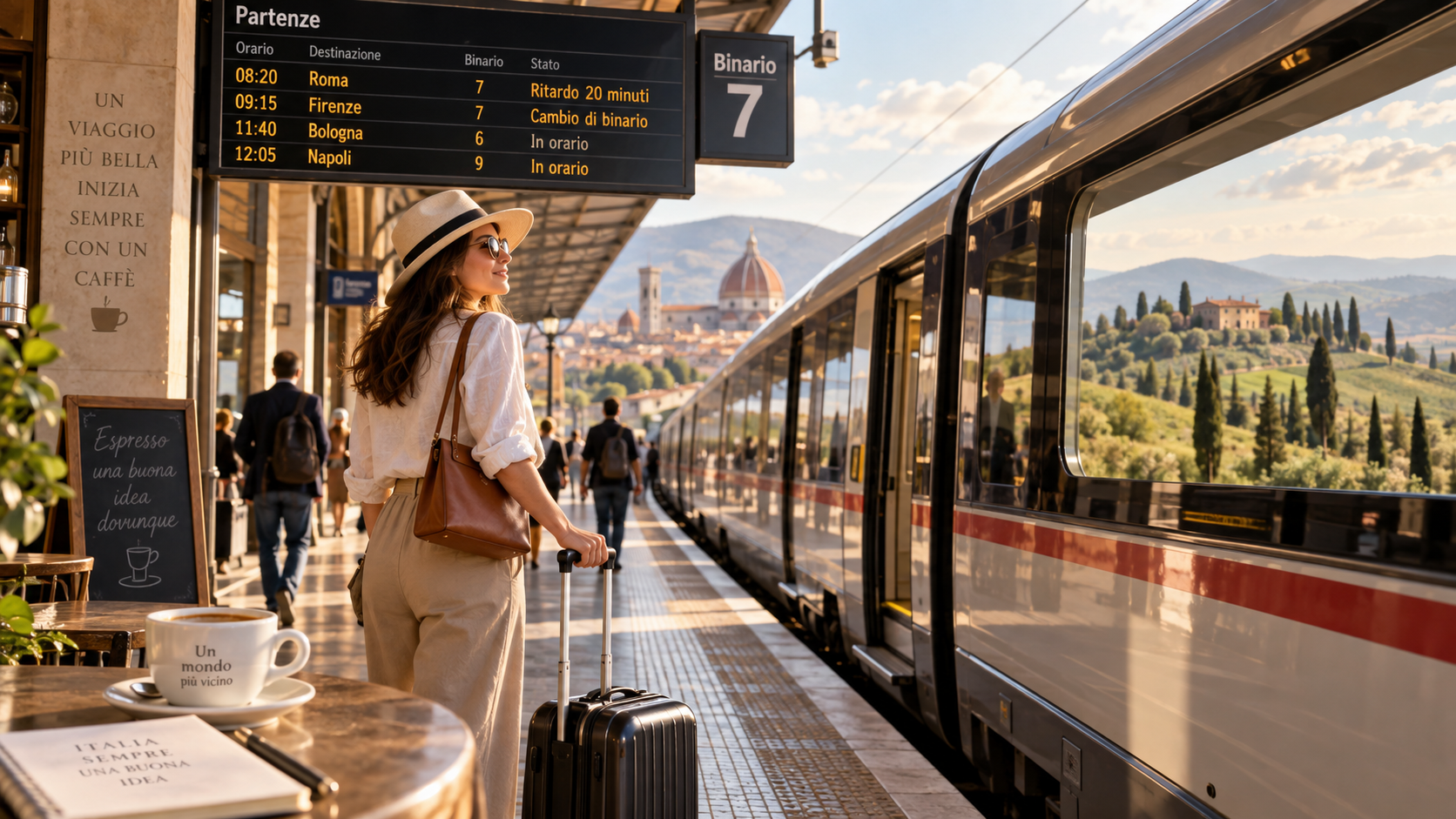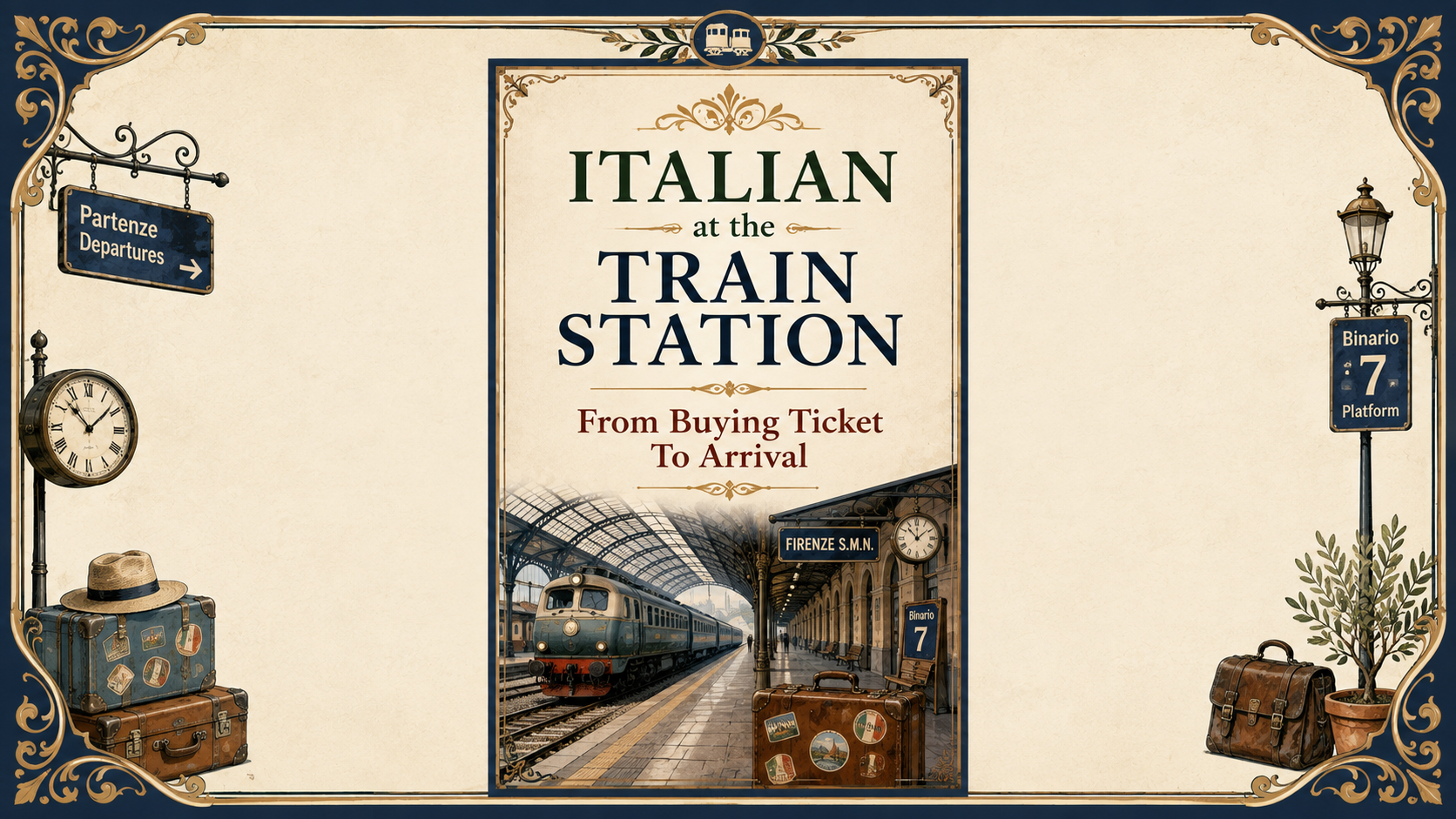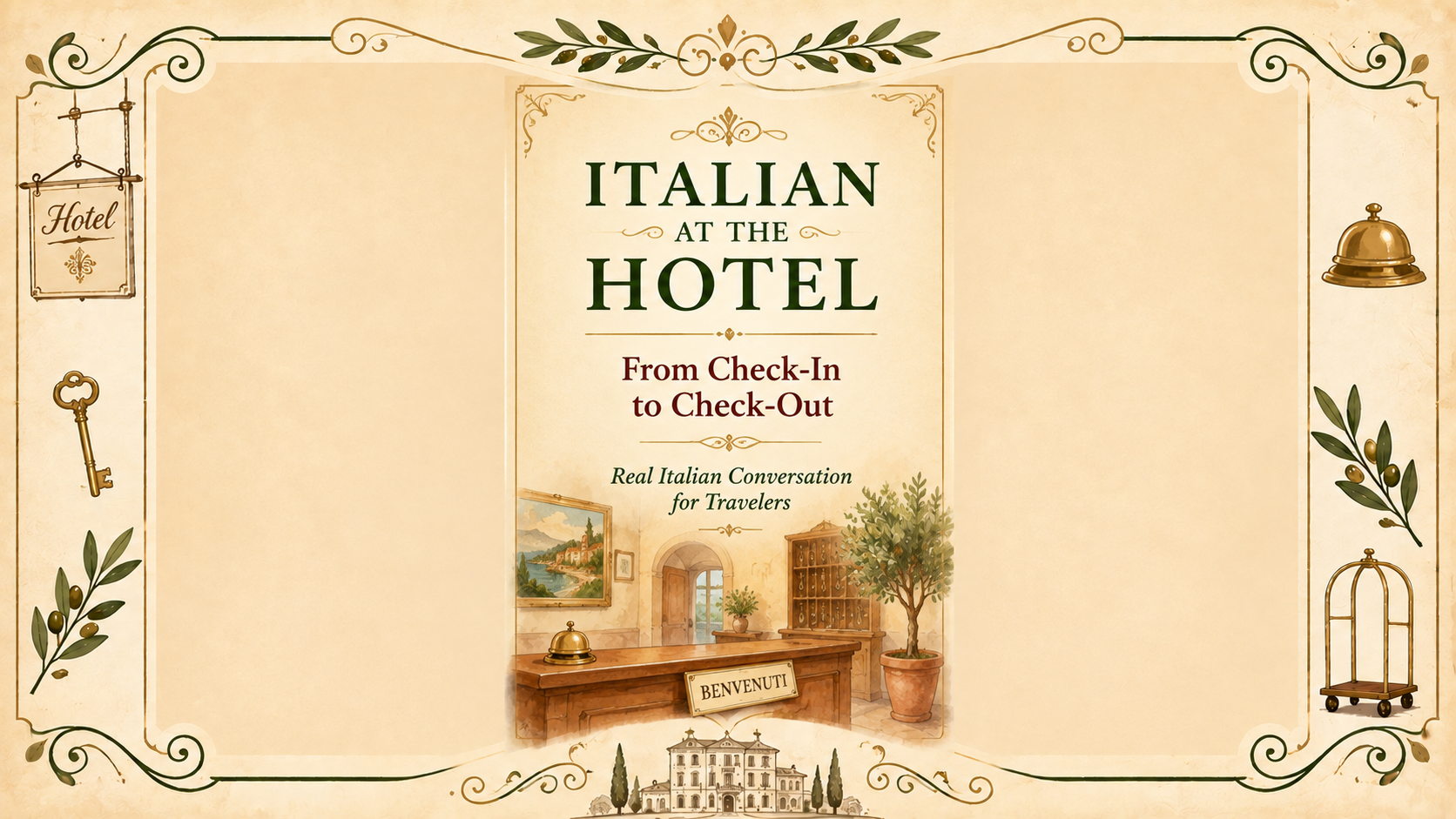
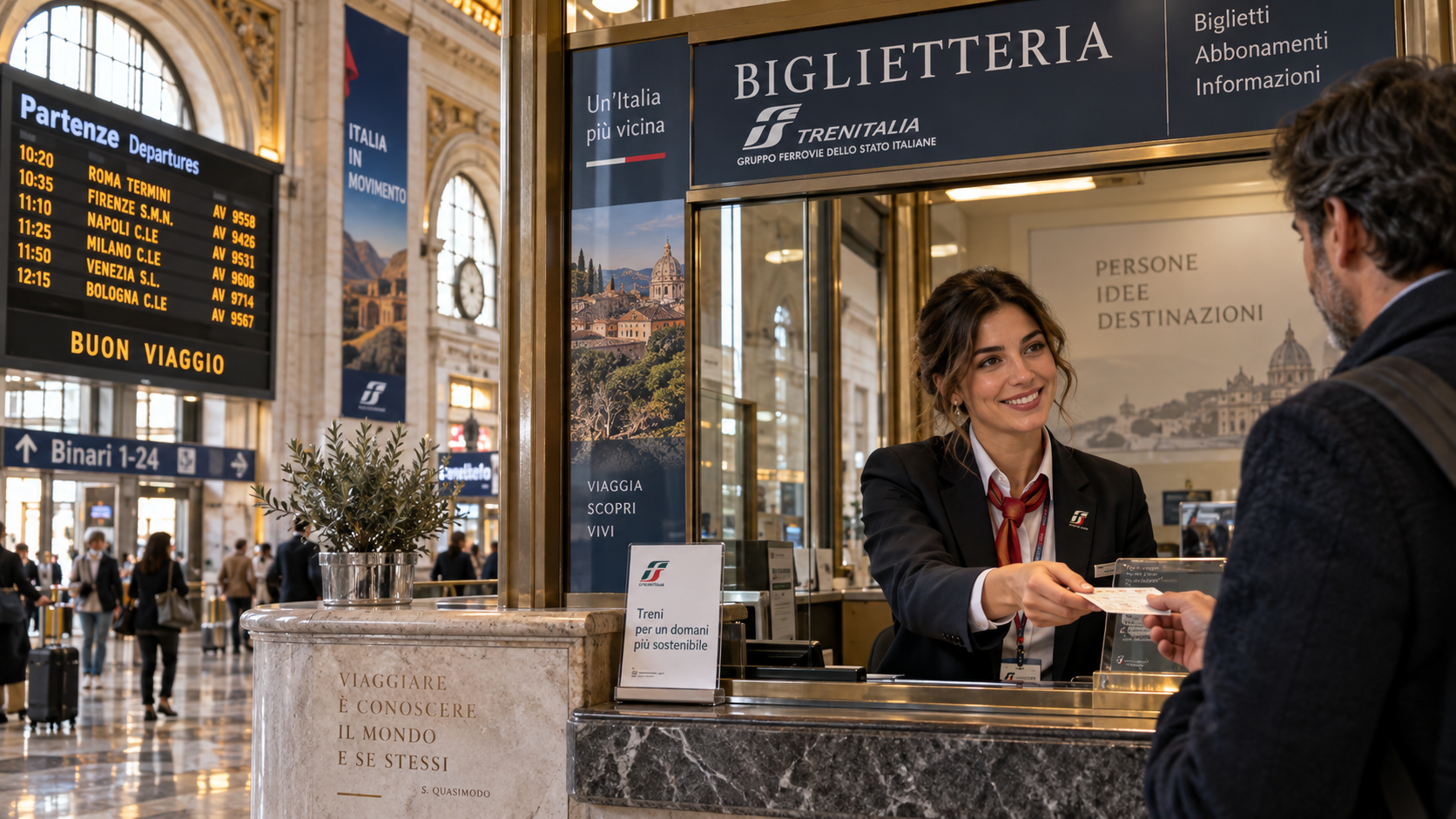
Knowing what to say at an Italian train station is only half the conversation. Learn useful phrases for tickets, platforms, delays, seats and arrivals — plus the replies you’re most likely to hear back.

ITALIAN IN REAL LIFE
You’ve learned some Italian. You know how to ask for a ticket and recognize a few travel words.
Then you arrive at an Italian train station — announcements are playing, departure boards are changing, and someone behind the counter starts speaking Italian.
This complete lesson takes you through a realistic train journey in Italy, helping you understand what you may actually hear and know what to say back.
In this lesson, you’ll follow a complete train journey through eight practical conversations:
Part 1 — Buying the Ticket
Part 2 — Choosing the Seat and Paying
Part 3 — Finding the Platform
Part 4 — The Train Is Delayed
Part 5 — The Platform Changes
Part 6 — Finding the Carriage and Seat
Part 7 — Ticket Inspection
Part 8 — Arriving
You’ll learn how to buy a train ticket, choose your seat, ask where your train leaves from, understand delays and platform changes, find your carriage and seat, speak with the conductor and know what to say when you arrive at your destination.
More importantly, you’ll hear these phrases as part of realistic conversations — so you can practise understanding what someone might actually say to you.
Learning how to ask a question is only half the conversation.
Imagine you’re standing at the station and hear:
Il treno ha un ritardo di venti minuti.
The train is twenty minutes late.
Or suddenly:
Il binario è cambiato.
The platform has changed.
You need to understand what was said — and know what to do next.
That’s the gap Proficiency Consultant is designed to bridge.
We focus on real phrases, realistic conversations and the Italian you’re likely to hear when travelling in Italy — so the language feels familiar when you actually need it.
Want to practise these conversations yourself?
Visit the Proficiency Consultant Italian Library for downloadable learning materials, including FREE PDFs from the Italian Train Travel series and many more practical Italian lessons.
Use the PDFs alongside the video to review the conversations, practise the phrases and prepare before your next journey through Italy.
Learn the Italian you’ll actually need.
Understand what Italians may actually say.
Know what to say when the conversation suddenly becomes real.
You’ve studied Italian. You know some vocabulary and useful phrases.
Then you arrive at an Italian hotel — and the receptionist starts talking.
This complete lesson takes you from check-in to check-out through realistic Italian conversations, helping you understand what you may actually hear in Italy and know what to say back.
In this lesson, you’ll follow an entire hotel stay through eight practical conversations:
Part 1 — Arriving at the Hotel
Part 2 — Room and Breakfast Information
Part 3 — Wi-Fi
Part 4 — A Problem With the Room
Part 5 — Making a Request
Part 6 — Asking About Check-Out
Part 7 — Checking Out
Part 8 — Leaving the Hotel
You’ll learn how to check in, ask about your room and breakfast, connect to the Wi-Fi, report a problem, make requests, ask about check-out, pay your bill, leave your luggage at reception and arrange a taxi.
More importantly, you’ll hear these phrases as part of realistic conversations — so you can practise understanding what someone might actually say to you.
Learning what you want to say is only half the conversation.
Imagine you’re standing at reception and hear:
Posso vedere il Suo documento d’identità?
May I see your ID?
You have a few seconds to understand what was said and respond.
That’s the gap Proficiency Consultant is designed to bridge.
We focus on real phrases, realistic conversations and the Italian you’re likely to hear when travelling in Italy — so the language feels familiar when you actually need it.
Want to practise these conversations yourself?
Visit the Proficiency Consultant Italian Library for downloadable learning materials, including FREE PDFs from the Italian at the Hotel series and many more practical Italian lessons.
Use the PDFs alongside the video to review the conversations, practise the phrases and prepare before your next trip to Italy.
Learn the Italian you’ll actually need.
Understand what Italians may actually say.
Know what to say when the conversation suddenly becomes real.
In this lesson you'll learn what to say when you’re ordering food at a restaurant in Italy but don’t know which dish to choose. Whether everything on the menu looks delicious or you simply want to try a local specialty, this useful Italian phrase will help you ask your server for a recommendation with confidence.
This is one of the most practical expressions for anyone travelling in Italy, especially when you want to discover authentic Italian dishes without already knowing everything on the menu.
Italian Phrase:
Che cosa mi consiglia?
English:
What do you recommend?
The verb “consigliare” means “to recommend.” By learning the phrase “Che cosa mi consiglia?”, you can politely ask a waiter, hotel employee, shop assistant, or another person for their recommendation in many everyday situations.
In this lesson you'll learn how to reserve a table at a restaurant in Italian. Whether you've found a charming local trattoria or a popular restaurant in the city, knowing this simple phrase will help you make a reservation confidently and avoid disappointment.
This is one of the most useful expressions for anyone travelling in Italy, especially during busy evenings when many restaurants require reservations.
Italian Phrase:
Vorrei prenotare un tavolo per stasera.
English:
I would like to reserve a table for tonight.
By learning the phrase "Vorrei prenotare..." you'll also be able to adapt it to many other situations, making it an excellent expression to add to your everyday Italian vocabulary.
In this lesson you'll learn how to ask which platform your train leaves from in Italian. This is one of the most useful phrases to know when travelling through Italy by train, especially in busy stations like Milano Centrale, Roma Termini, or Firenze Santa Maria Novella.
Whether you're visiting Italy for the first time or simply want to travel with more confidence, this practical phrase will help you communicate naturally with station staff and find your train quickly.
Italian Phrase:
Da quale binario parte il treno per Milano?
English:
Which platform does the train to Milan leave from?
Traveling by train in Italy?
Learn how to ask “Questo treno va a Firenze?”, meaning “Does this train go to Florence?”
This practical Italian phrase uses questo treno (this train), va a (goes to), and Firenze (Florence). A simple and useful question for checking your train destination while traveling in Italy.
Lost your luggage in Italy? Don't panic.
In this short Italian lesson, you'll learn one essential travel phrase that can help you at the airport if your suitcase doesn't arrive.
Italian Phrase:
Non trovo il mio bagaglio.
English: I can't find my luggage.
A simple sentence that can make a stressful travel situation much easier.
Watch the lesson, practice the pronunciation, and travel Italy with more confidence.
Learn a simple and practical Italian phrase for hotel stays in Italy. In this lesson, you'll discover how to ask whether breakfast is included with your room reservation.
This is a common question travelers ask when checking into a hotel and can help you avoid confusion about meals and extra charges. The phrase is easy to remember, useful in real-life situations, and perfect for beginners preparing for a trip to Italy.
"La colazione è inclusa?" which means "Is breakfast included?
Arriving at your hotel in Italy is exciting, but sometimes you need a little help communicating.
One of the most useful questions you can ask is:
A che ora è la colazione?
This simple phrase means:
"What time is breakfast?"
Whether you're staying in a hotel, bed and breakfast, or guesthouse, knowing how to ask about breakfast times can make your stay much easier.
In this lesson you'll learn:
The Italian phrase for asking about breakfast
The English translation
When to use it
A practical travel situation you may encounter in Italy
Learning simple phrases like this can help you feel more confident and independent while traveling.
Italian Phrase:
A che ora è la colazione?
English Translation:
What time is breakfast
Learn how to ask:
Qual è la password del WiFi?
(What is the WiFi password?)
A practical Italian expression for travelers, tourists, students, and expats who want to communicate confidently during their stay in Italy.
Watch the video lesson, practice the pronunciation, and start using real-life Italian today.
Staying in a hotel in Italy and need an extra towel?
In this lesson, you'll learn the simple and practical phrase "Posso avere un altro asciugamano?" (Can I have another towel?).
This is a useful expression that can help make your hotel stay more comfortable while traveling in Italy. As part of our Italian In Real Life series, this lesson focuses on real situations you'll encounter during your trip.
This useful hotel phrase helps travelers explain that the air conditioning isn’t working and get assistance during their stay in Italy.
“C’è un problema con l’aria condizionata” in Italian.
There is a problem with air conditioning.
The Italian expression avere fretta means “to be in a hurry.”
It is a very common everyday expression used when you do not have much time or need to move quickly.
Example:
“Scusa, ho fretta.”
Sorry, I’m in a hurry.
Another example:
“Abbiamo fretta.”
We’re in a hurry.
You may hear this expression while traveling, commuting, shopping, or during busy daily situations.
Learn practical Italian expressions and how Italians naturally speak in everyday life.
You arrive at your hotel room after a long trip. You try the key card… but it doesn’t work.
Don’t panic. You only need one simple phrase:
“La chiave non funziona.”
The key doesn’t work.
This useful travel phrase can help you communicate quickly at hotels and feel more confident during your trip to Italy.
Learn practical Italian for real travel situations.
Italian Idioms #12: Essere A Pezzi
The Italian expression essere a pezzi literally translates to “to be in pieces,” but Italians use it to mean being exhausted, extremely tired, or worn out.
You may hear this phrase after work, travel, studying, or any busy day.
“Dopo il lavoro sono a pezzi.”
After work I’m exhausted.
In this lesson, practice pronunciation and learn how Italians naturally use this common expression.
Italians often speak quickly in everyday conversations. You almost understand… but not quite.
You don’t need perfect Italian. Sometimes one simple phrase is enough to keep the conversation going.
“Può ripetere, per favore?”
Can you repeat, please?
This useful travel phrase can help you feel more confident when speaking with native Italian speakers.
Learn simple, real-life Italian for travel and everyday situations.
You arrive at your hotel in Italy. The receptionist asks about your reservation… but you’re not sure what to say.
Don’t worry. Learning a few simple phrases can make hotel check-in much easier.
“Ho una prenotazione.”
I have a reservation.
Learning practical Italian for travel situations can help you feel more confident and enjoy your trip to Italy.