
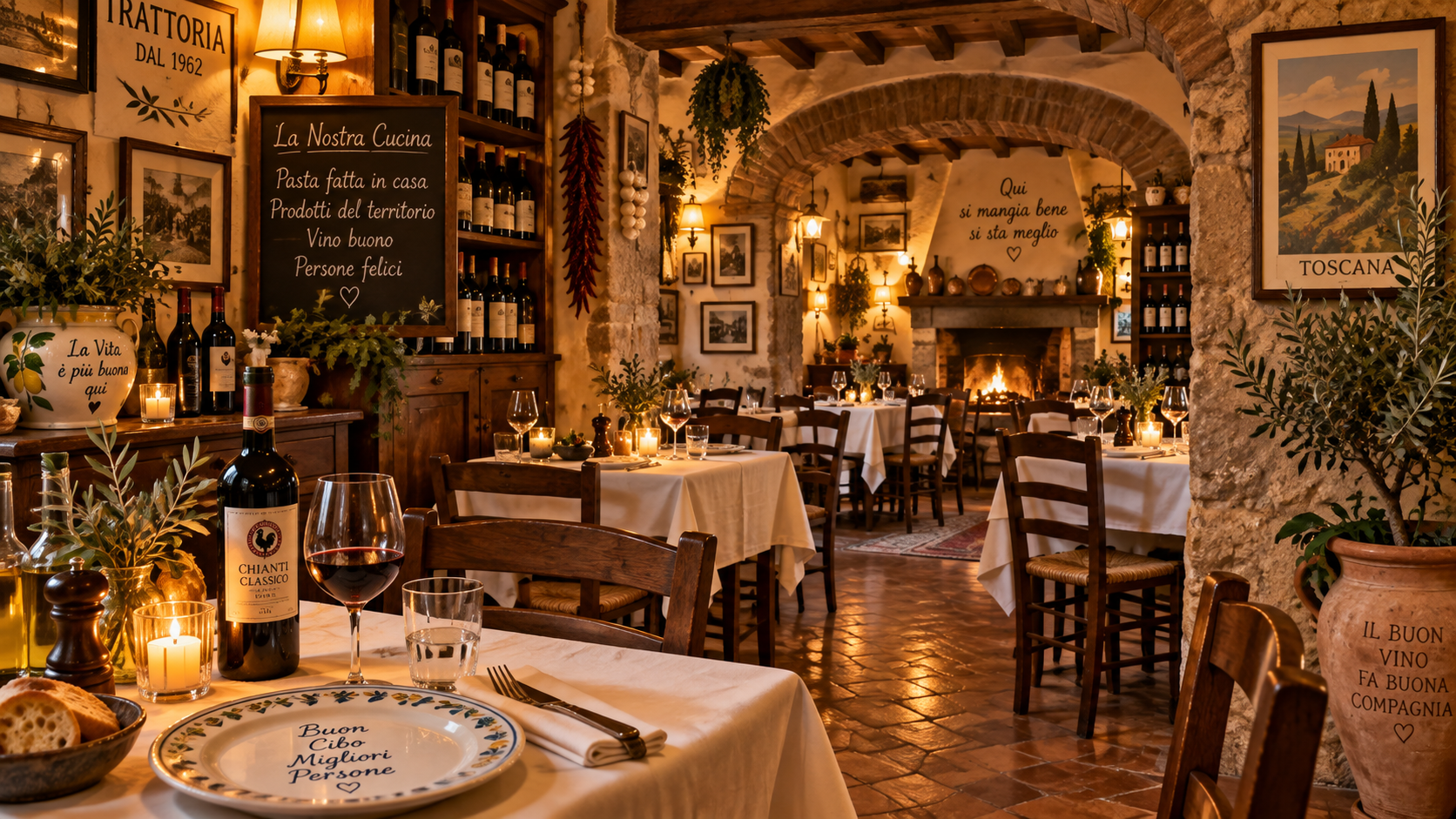
Walking into a restaurant in Italy can feel wonderfully familiar.
Tables.
Menus.
Wine.
Pasta.
Someone asking if you have a reservation.
And yet the experience often unfolds a little differently from what many travelers are used to.
Meals tend to move at their own pace.
Menus are structured differently.
Waiters may ask questions you weren’t expecting.
And the whole evening can feel much easier if you already know what is likely to happen next.
So here’s what to expect.
You May Be Asked Where You’d Like to Sit
If you have a reservation, one of the first things you might say is:
Abbiamo una prenotazione a nome di Rossi.
We have a reservation under the name Rossi.
You may then hear:
Preferite un tavolo fuori sulla terrazza o dentro il ristorante?
Would you prefer a table outside on the terrace or inside the restaurant?
If the weather is good, the terrace is usually difficult to resist.
You can say:
Sulla terrazza sarebbe perfetto.
On the terrace would be perfect.
And then:
Prego, seguitemi.
Please, follow me.
A promising start.
Drinks Usually Come First
Once you’re seated, the waiter may bring the menus and ask:
Desiderate qualcosa da bere?
Would you like something to drink?
A very common answer is:
Vorremmo una bottiglia d’acqua, per favore.
We’d like a bottle of water, please.
Then comes the inevitable question:
Naturale o frizzante?
Still or sparkling?
If you want still water:
Naturale, grazie.
If you want sparkling:
Frizzante, grazie.
You can also ask for a recommendation:
Ci potrebbe consigliare un vino bianco, per favore?
Could you recommend a white wine for us, please?
That can be one of the nicest parts of the meal.
Especially if the waiter recommends something local.
You Don’t Need to Understand Every Dish
Italian menus can be wonderful.
They can also contain dishes you’ve never seen before.
That’s completely normal.
If you don’t know what something is, ask.
For example:
Che cos’è la tagliata di manzo?
What is tagliata di manzo?
The waiter may explain:
È la carne di manzo grigliata, tagliata a fette.
It’s grilled beef, sliced into pieces.
You can also ask:
Che cosa mi consiglia come primo piatto?
What do you recommend as a first course?
And you may hear:
Le consiglio le pappardelle al ragù di cinghiale.
I recommend the pappardelle with wild boar ragù.
Sometimes that is exactly how you discover the best thing on the menu.
The Waiter May Ask If You Need More Time
You won’t necessarily be expected to order immediately.
You may hear:
Volete ordinare o vi serve ancora un po’ di tempo?
Would you like to order or do you need a little more time?
If you’re not ready:
Abbiamo bisogno ancora di qualche minuto.
We need a few more minutes.
Simple.
No need to panic-order something because the waiter has appeared.
The Meal May Be Ordered in Courses
A traditional Italian menu may include:
antipasti — starters
primi — first courses
secondi — main meat or fish dishes
contorni — side dishes
dolci — desserts
Again, you do not have to order everything.
You can keep it simple.
For example:
Come antipasto, vorremmo una bruschetta da dividere.
As a starter, we’d like a bruschetta to share.
Then:
Per me le pappardelle al ragù di cinghiale.
For me, the pappardelle with wild boar ragù.
And:
La tagliata di manzo.
The sliced grilled beef.
The waiter may then ask:
Come desidera la carne?
How would you like the meat cooked?
Or:
Desiderate anche un contorno?
Would you also like a side dish?
That is where words like patate al forno — roasted potatoes — become very useful.
Special Requests Are Completely Normal
If someone has an allergy or dietary concern, say so clearly.
For example:
Il mio compagno è allergico alle noci.
My companion is allergic to nuts.
Then ask:
Ci sono noci in uno dei piatti che abbiamo ordinato?
Are there nuts in any of the dishes we ordered?
A careful waiter may respond:
Preferisco controllare con il cuoco.
I’d prefer to check with the chef.
That is a very good response to hear.
And if there is a possible cross-contact issue, the waiter may explain that too.
If you then decide not to order something:
Preferiamo non prendere la bruschetta.
We’d prefer not to have the bruschetta.
Perfectly reasonable.
If Something Is Wrong, Say So Politely
Mistakes happen.
Maybe you ordered roasted potatoes and received grilled vegetables.
You can say:
Credo che ci sia un piccolo problema.
I think there’s a small problem.
Then explain what happened:
Avevamo ordinato le patate al forno.
We had ordered the roasted potatoes.
You may hear:
Ha ragione. Le chiedo scusa. È un mio errore.
You’re right. I apologize. It’s my mistake.
And:
Le porto subito le patate al forno.
I’ll bring you the roasted potatoes right away.
Problem solved.
No need for drama.
Dessert and Coffee Come at the End
Once the main meal is finished, the waiter may ask:
Tutto bene?
Is everything okay?
You can answer:
Tutto era buonissimo.
Everything was delicious.
Then you may hear:
Desiderate vedere il menù dei dolci?
Would you like to see the dessert menu?
You can ask:
Quale ci consiglia?
Which one do you recommend?
And perhaps hear:
Il tiramisù è fatto in casa.
The tiramisu is homemade.
At that point, resistance may be futile.
You can say:
Prendiamo un tiramisù da dividere.
We’ll have one tiramisu to share.
And then perhaps coffee.
Per me un espresso.
An espresso for me.
Simple.
Very Italian.
You Usually Ask for the Bill When You’re Ready
When you are finished, you can say:
Possiamo avere il conto, per favore?
Could we have the bill, please?
The waiter may reply:
Certamente. Ve lo porto subito.
Certainly. I’ll bring it right away.
You can also ask:
Possiamo pagare con la carta?
Can we pay by card?
And if you want to split the bill:
Sarebbe possibile pagare separatamente?
Would it be possible to pay separately?
The waiter may then ask:
Come volete dividere il conto?
How would you like to split the bill?
If you want half each:
A metà, per favore.
Half each, please.
Then you pay, ask for the receipt if you need one, and hopefully finish with:
Abbiamo mangiato molto bene.
We really enjoyed the meal.
The Evening Is Part of the Experience
The most important thing to expect from an authentic Italian restaurant is not one particular dish or phrase.
It is the rhythm of the meal.
You arrive.
You sit down.
You order drinks.
You take your time with the menu.
You ask questions.
You eat.
You talk.
You consider dessert.
You probably order coffee.
And eventually, when you are ready, you ask for the bill.
The experience is often slower, more social and more relaxed than travelers expect.
And knowing a few phrases makes the whole evening feel much more natural.
That’s exactly what we cover in our Italian at the Restaurant — From Arriving to Paying the Bill lesson.
It follows the complete restaurant experience from the moment you arrive until the moment you leave.
Watch the Complete Restaurant Conversation
You can watch the full lesson free on YouTube.
It includes arriving with a reservation, choosing a table, ordering drinks, understanding the menu, asking for recommendations, dealing with allergies, fixing a mistake, ordering dessert and paying the bill.
[YOUTUBE VIDEO EMBED HERE]
Because knowing how to order pasta is useful.
Knowing what happens before and after that is even better.
Free Italian PDFs
Want to practice before your next trip?
We also have FREE Italian PDFs covering restaurants, hotels, travel situations, everyday conversations and useful vocabulary.
———CLICK HERE FOR THE FREE PDFs———
You don’t need perfect Italian to enjoy a restaurant in Italy.
You just need enough to follow the evening.
And enough to know what to say when it’s your turn.
CONTINUE LEARNING ITALIAN FOR TRAVEL