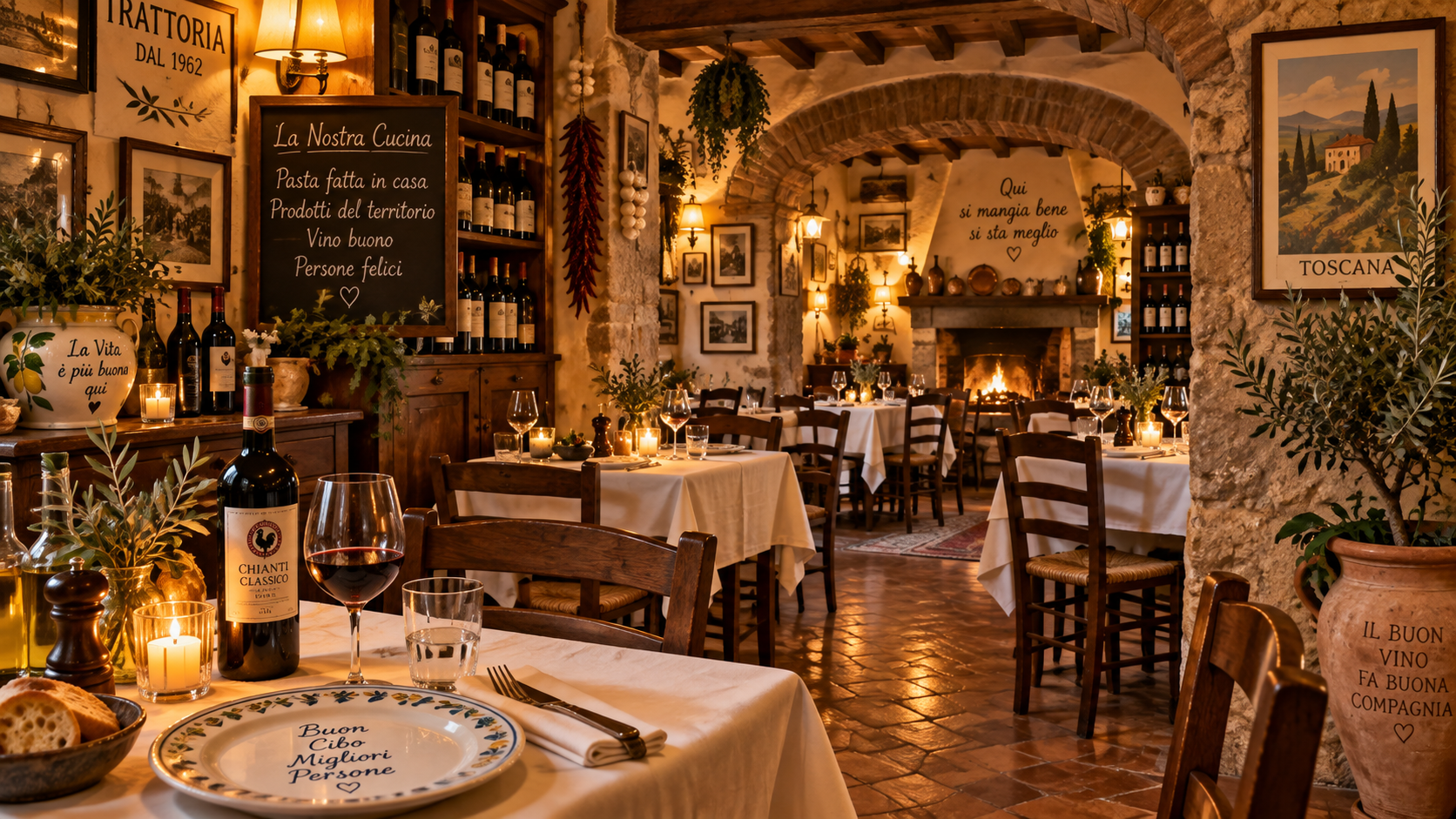
Wondering what to expect at an authentic Italian restaurant? Follow the experience from arriving and ordering drinks to understanding the menu, choosing courses, dessert, coffee and paying the bill.

ITALIAN IN REAL LIFE
You’ve studied Italian. You know some vocabulary and useful phrases.
Then you arrive at an Italian hotel — and the receptionist starts talking.
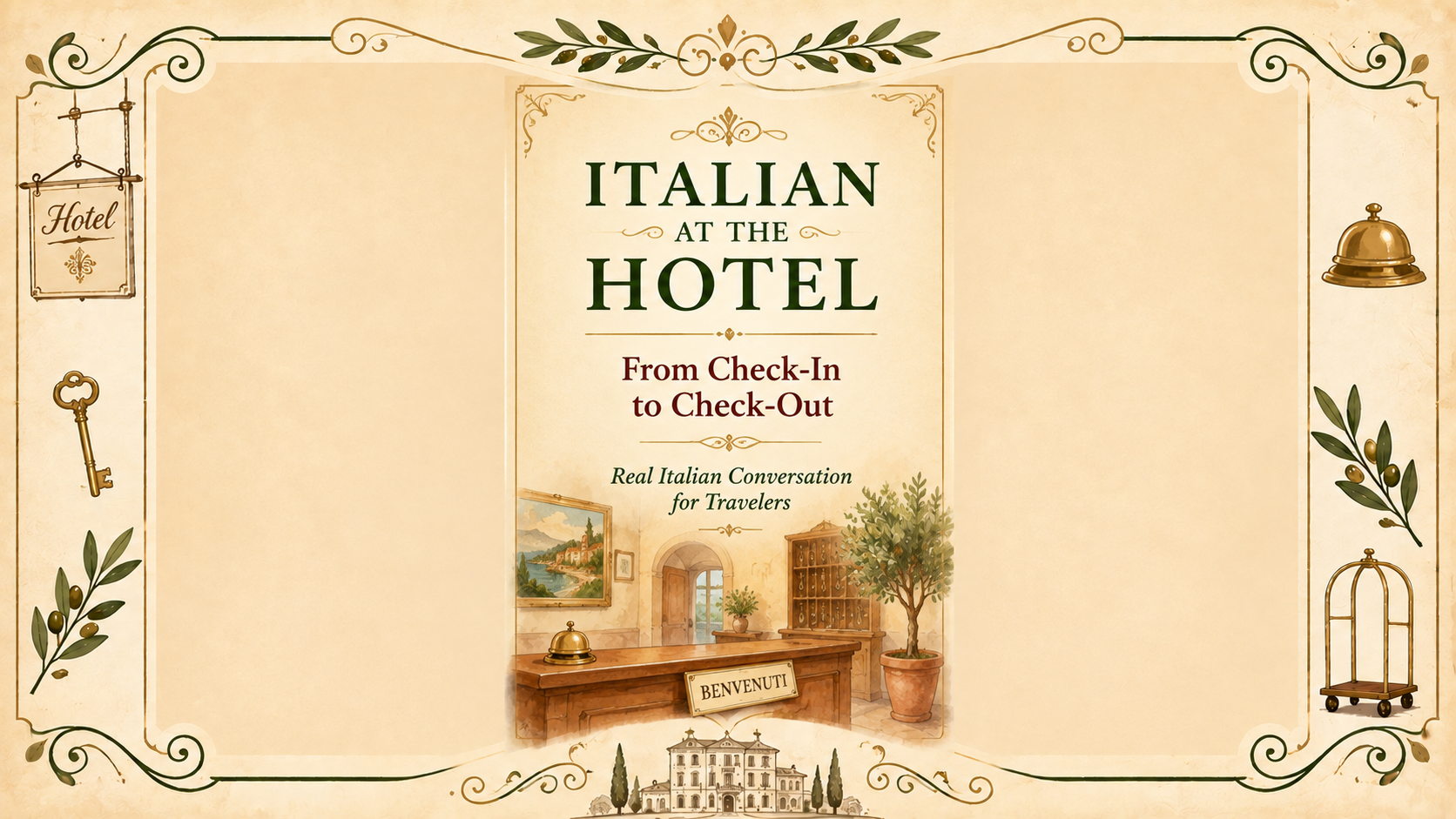
This complete lesson takes you from check-in to check-out through realistic Italian conversations, helping you understand what you may actually hear in Italy and know what to say back.
In this lesson, you’ll follow an entire hotel stay through eight practical conversations:
Part 1 — Arriving at the Hotel
Part 2 — Room and Breakfast Information
Part 3 — Wi-Fi
Part 4 — A Problem With the Room
Part 5 — Making a Request
Part 6 — Asking About Check-Out
Part 7 — Checking Out
Part 8 — Leaving the Hotel
You’ll learn how to check in, ask about your room and breakfast, connect to the Wi-Fi, report a problem, make requests, ask about check-out, pay your bill, leave your luggage at reception and arrange a taxi.
More importantly, you’ll hear these phrases as part of realistic conversations — so you can practise understanding what someone might actually say to you.
Learning what you want to say is only half the conversation.
Imagine you’re standing at reception and hear:
Posso vedere il Suo documento d’identità?
May I see your ID?
You have a few seconds to understand what was said and respond.
That’s the gap Proficiency Consultant is designed to bridge.
We focus on real phrases, realistic conversations and the Italian you’re likely to hear when travelling in Italy — so the language feels familiar when you actually need it.
Want to practise these conversations yourself?
Visit the Proficiency Consultant Italian Library for downloadable learning materials, including FREE PDFs from the Italian at the Hotel series and many more practical Italian lessons.
Use the PDFs alongside the video to review the conversations, practise the phrases and prepare before your next trip to Italy.
Learn the Italian you’ll actually need.
Understand what Italians may actually say.
Know what to say when the conversation suddenly becomes real.
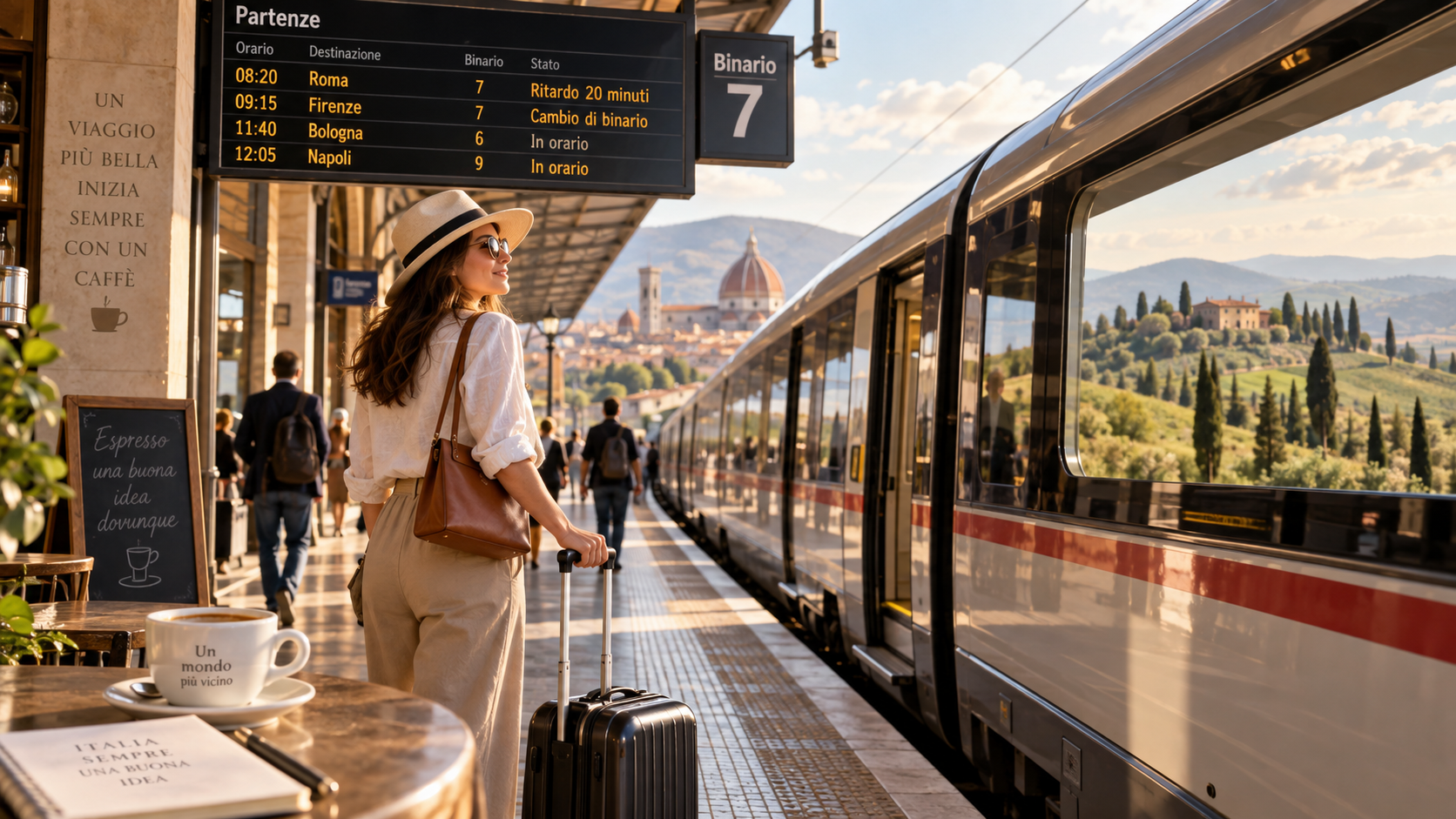
Traveling by train in Italy?
Learn how to ask “Questo treno va a Firenze?”, meaning “Does this train go to Florence?”
This practical Italian phrase uses questo treno (this train), va a (goes to), and Firenze (Florence). A simple and useful question for checking your train destination while traveling in Italy.
Learning the days of the week, months, and seasons is one of the most useful foundations for speaking Italian naturally in everyday life.
In this lesson, you’ll learn how Italians talk about schedules, routines, appointments, seasons, and daily activities using simple and practical vocabulary.
Lunedì — Monday
Martedì — Tuesday
Mercoledì — Wednesday
Giovedì — Thursday
Venerdì — Friday
Sabato — Saturday
Domenica — Sunday
Oggi è lunedì. — Today is Monday.
Martedì vado in palestra. — On Tuesday, I go to the gym.
Mercoledì sera guardo un film. — On Wednesday evening, I watch a movie.
Giovedì preparo la cena. — On Thursday, I prepare dinner.
Venerdì esco con i miei amici. — On Friday, I go out with my friends.
Sabato faccio una passeggiata al parco. — On Saturday, I take a walk in the park.
Domenica riposo e leggo un libro. — On Sunday, I relax and read a book.
This beginner-friendly Italian lesson is perfect for travel, conversation practice, and building confidence using practical everyday Italian vocabulary.
In this beginner-friendly Italian lesson, you’ll learn how to talk about your daily routine using practical and commonly used Italian vocabulary.
These expressions are perfect for everyday conversations, travel situations, language practice, and building confidence speaking Italian naturally.
Svegliarsi — To wake up
Alzarsi — To get up
Lavarsi i denti — To brush teeth
Fare la doccia — To take a shower
Prepararsi — To get ready
Vestirsi — To get dressed
Fare colazione — To have breakfast
Andare al lavoro — To go to work
Lavorare — To work
Studiare — To study
Pranzare — To have lunch
Preparare la cena — To prepare dinner
Cenare — To have dinner
Guardare la TV — To watch TV
Riposarsi — To rest
Andare a letto — To go to bed
Addormentarsi — To fall asleep
Talking about your daily activities is one of the fastest ways to begin forming real conversations in Italian. These verbs are used constantly in everyday speech and help learners describe schedules, habits, and routines naturally.
This lesson is ideal for beginners learning conversational Italian and practical real-life vocabulary.
Planning a trip to Italy? In this beginner-friendly Italian lesson, you’ll learn practical travel vocabulary and useful holiday-related expressions that can help you feel more confident while traveling.
This lesson introduces common Italian words connected to vacations, transportation, sightseeing, restaurants, museums, beaches, maps, and everyday travel situations.
La vacanza — Holiday / Vacation
Viaggiare — To travel
Il viaggio — Trip
La destinazione — Destination
La gita — Excursion
La spiaggia — Beach
Il mare — Sea
La montagna — Mountain
La città — City
Il paese — Country / Town
Il bagaglio — Luggage
Il bagaglio a mano — Hand luggage
La valigia — Suitcase
Lo zaino — Backpack
La guida turistica — Tour guide
La mappa — Map
Il museo — Museum
Il monumento — Monument
Il parco — Park
La piazza — Square
Il ristorante — Restaurant
Il caffè — Café
Il souvenir — Souvenir
La cartolina — Postcard
Whether you’re preparing for a vacation in Italy or simply expanding your beginner Italian vocabulary, these practical words and phrases are extremely useful for real-life conversations and travel situations.
In this beginner-friendly Italian lesson, you’ll learn how to talk about your daily routine using practical and commonly used Italian vocabulary.
These expressions are perfect for everyday conversations, travel situations, language practice, and building confidence speaking Italian naturally.
Svegliarsi — To wake up
Alzarsi — To get up
Lavarsi i denti — To brush teeth
Fare la doccia — To take a shower
Prepararsi — To get ready
Vestirsi — To get dressed
Fare colazione — To have breakfast
Andare al lavoro — To go to work
Lavorare — To work
Studiare — To study
Pranzare — To have lunch
Preparare la cena — To prepare dinner
Cenare — To have dinner
Guardare la TV — To watch TV
Riposarsi — To rest
Andare a letto — To go to bed
Addormentarsi — To fall asleep
Talking about your daily activities is one of the fastest ways to begin forming real conversations in Italian. These verbs are used constantly in everyday speech and help learners describe schedules, habits, and routines naturally.
This lesson is ideal for beginners learning conversational Italian and practical real-life vocabulary.
Going to a hair salon or barber in Italy can feel intimidating if you don’t know the right vocabulary. In this beginner-friendly Italian lesson, you’ll learn useful hairdresser-related words and expressions to help you communicate naturally during appointments.
This lesson covers hairstyles, haircuts, styling vocabulary, and practical beauty salon terms commonly used in Italy.
Il parrucchiere / La parrucchiera — Hairdresser (male/female)
Il barbiere — Barber
La barba — Beard
Il taglio di capelli — Haircut
Il colore — Hair color
La tinta — Hair dye
L’asciugacapelli — Hairdryer
Il prodotto per capelli — Hair product
Corto — Short
Lungo — Long
Medio — Medium
Lisci — Straight
Ricci — Curly
Ondulati — Wavy
La frangia — Bangs
La riga — Parting
Lo strato / Gli strati — Layer / Layers
La messa in piega — Hairstyling
La permanente — Perm
Il lavaggio e messa in piega — Hair wash and styling
These practical Italian phrases are useful for travelers, expats, students, and anyone living in or visiting Italy. Learning everyday vocabulary connected to personal care helps build real conversational confidence and makes daily interactions much easier.
In this beginner-friendly Italian lesson, you’ll learn how to express opinions, preferences, likes, and dislikes naturally in Italian conversation. These are some of the most useful everyday phrases for speaking Italian confidently while traveling, meeting people, or improving conversational fluency.
This lesson focuses on practical Italian expressions you can use immediately in real-life situations.
Penso che — I think that
Secondo me — According to me / In my opinion
Penso che l’Italia sia un paese bellissimo.
— I think that Italy is a beautiful country.
Secondo me, la cucina italiana è la migliore del mondo.
— In my opinion, Italian cuisine is the best in the world.
Mi piace — I like
Non mi piace — I don’t like
Adoro — I love
Odio — I hate
Mi piace molto la musica italiana.
— I really like Italian music.
Non mi piace il cibo piccante.
— I don’t like spicy food.
Adoro il gelato italiano.
— I love Italian gelato.
Odio la pioggia.
— I hate rain.
Learning how to express opinions in Italian helps you:
sound more natural in conversations
discuss food, travel, music, culture, and hobbies
build confidence speaking Italian
improve everyday conversational skills
communicate personal preferences clearly
These are essential Italian phrases for beginners and travelers who want to move beyond simple vocabulary and start speaking more naturally.
In this beginner-friendly Italian lesson, you’ll learn how to talk about your hobbies, interests, passions, and favorite activities in Italian. These are essential conversational phrases that help you connect naturally with native speakers and build confidence in everyday Italian conversations.
Whether you’re traveling to Italy, meeting Italian speakers, or improving your conversational skills, this lesson will help you express your interests more naturally.
Mi piace… — I like…
Mi piace molto… — I really like…
Sono appassionato/a di… — I’m passionate about…
Adoro… — I love…
Mi appassiona… — I am passionate about…
Ho un grande interesse per… — I have a great interest in…
Quali sono i tuoi interessi?
— What are your interests?
Qual è il tuo hobby preferito?
— What is your favorite hobby?
Cosa ti piace fare nel tempo libero?
— What do you like to do in your free time?
Hai qualche hobby che ti appassiona?
— Do you have any hobbies you’re passionate about?
Learning how to discuss hobbies and interests in Italian helps you:
start natural conversations
make friends while traveling
improve speaking confidence
talk about music, sports, books, food, and activities
sound more conversational and less textbook-like
These practical Italian phrases are especially useful for beginners who want to move beyond memorizing vocabulary and begin speaking Italian in real situations.
Perfect for:
beginner Italian learners
travelers to Italy
conversational Italian practice
students improving fluency
everyday Italian communication
In this beginner-friendly Italian lesson, you’ll learn useful Italian phrases for asking for directions and finding places while traveling in Italy. These practical expressions are essential for tourists, travelers, and anyone starting to learn conversational Italian.
This lesson covers how to politely ask for help, ask where places are located, and understand common transportation-related vocabulary.
Scusi — Excuse me (formal)
Scusa — Excuse me (informal)
Può aiutarmi? — Can you help me? (formal)
Puoi aiutarmi? — Can you help me? (informal)
Dove si trova [place]? — Where is [place]?
Dove si trova il museo? — Where is the museum?
Come arrivo a [place]? — How do I get to [place]?
Come arrivo all’Hotel San Francesco? — How do I get to Hotel San Francesco?
La stazione ferroviaria — The train station
La fermata dell’autobus — The bus stop
L’aeroporto — The airport
L’hotel — The hotel
Perfect for beginner Italian learners who want practical Italian they can use immediately during travel and everyday situations.