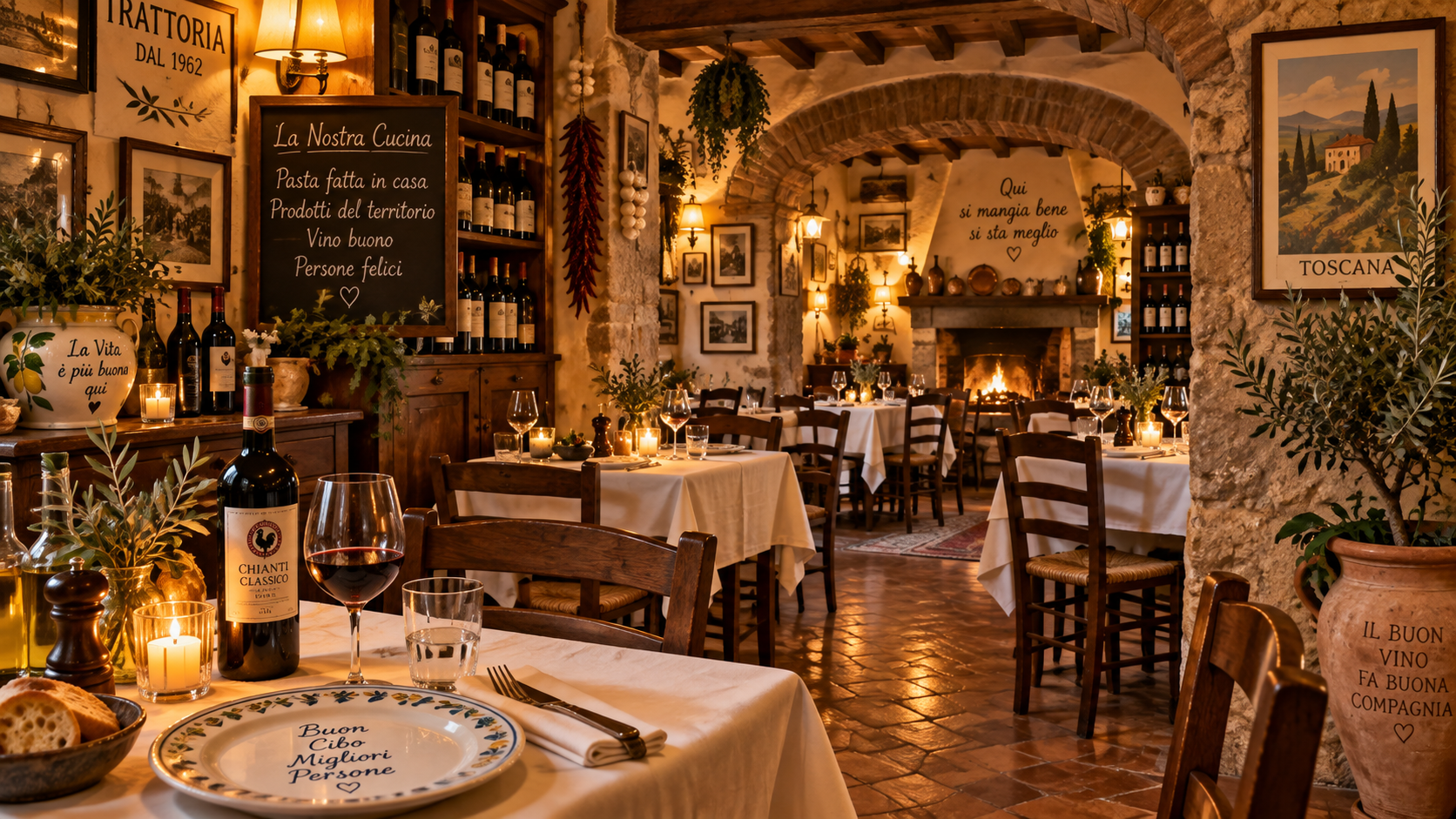
Wondering what to expect at an authentic Italian restaurant? Follow the experience from arriving and ordering drinks to understanding the menu, choosing courses, dessert, coffee and paying the bill.

ITALIAN IN REAL LIFE
This useful hotel phrase helps travelers explain that the air conditioning isn’t working and get assistance during their stay in Italy.
“C’è un problema con l’aria condizionata” in Italian.
There is a problem with air conditioning.
Italians often speak quickly in everyday conversations. You almost understand… but not quite.
You don’t need perfect Italian. Sometimes one simple phrase is enough to keep the conversation going.
“Può ripetere, per favore?”
Can you repeat, please?
This useful travel phrase can help you feel more confident when speaking with native Italian speakers.
Learn simple, real-life Italian for travel and everyday situations.
You arrive at your hotel in Italy. The receptionist asks about your reservation… but you’re not sure what to say.
Don’t worry. Learning a few simple phrases can make hotel check-in much easier.
“Ho una prenotazione.”
I have a reservation.
Learning practical Italian for travel situations can help you feel more confident and enjoy your trip to Italy.
You’re in Italy. Someone starts speaking… and you don’t understand.
Don’t panic. One simple phrase can help.
“Mi dispiace… non capisco.”
I’m sorry… I don’t understand.
This phrase is useful when speaking with locals, asking questions, shopping, traveling, or navigating everyday situations.
Learn practical Italian for real-life conversations and travel.
Small talk is an important part of Italian culture. Whether you are sitting in a café, meeting new people, traveling through Italy, or having a casual conversation, knowing a few natural Italian phrases can help you feel more confident and connected.
In this lesson, you’ll learn useful Italian expressions for asking questions, starting conversations, and giving compliments in everyday situations.
Some of the phrases included in this lesson are:
Di dove sei?
(Where are you from?)
Ti piace vivere qui?
(Do you like living here?)
Qual è il tuo hobby preferito?
(What’s your favorite hobby?)
Cosa fai di bello?
(What do you do for a living?)
Da quanto tempo vivi in questa città?
(How long have you been living in this city?)
Che bel vestito!
(What a beautiful dress!)
Mi piace molto il tuo sorriso.
(I really like your smile.)
Lei è molto gentile!
(You are very kind!)
Stai benissimo con questo vestito.
(You look amazing in this dress.)
These are natural Italian phrases that can help you sound more relaxed, friendly, and conversational while speaking with native Italians.
Perfect for beginners, travelers, and anyone who wants to improve their real-world Italian conversation skills.
Italy is full of beautiful cities, charming villages, historic buildings, beaches, mountains, and unforgettable landscapes. In this lesson, you’ll learn useful Italian vocabulary and adjectives for describing places naturally and confidently.
You’ll also learn important grammar rules for using adjectives correctly in Italian conversation.
Some of the vocabulary and examples included in this lesson are:
Italian adjectives usually agree with the noun in gender and number.
Examples:
Una città bella
(A beautiful city)
Paesaggi belli
(Beautiful landscapes)
Adjectives usually come after the noun in Italian.
Examples:
Una spiaggia bella
(A beautiful beach)
Un edificio moderno
(A modern building)
Bello/a — Beautiful
Antico/a — Ancient
Moderno/a — Modern
Tranquillo/a — Peaceful
Vivace — Lively
Incantevole — Enchanting
Pittoresco — Picturesque
Fascinoso — Fascinating
Maestoso — Majestic
Caotico — Chaotic
Rilassante — Relaxing
Affollato — Crowded
Luminoso — Bright
Rustico — Rustic
Piacevole — Enjoyable
This lesson is perfect for beginners, travelers, and anyone who wants to speak more naturally when talking about Italy, travel, cities, beaches, restaurants, neighborhoods, and everyday experiences.
Politeness is an important part of everyday communication in Italy. Simple expressions like “thank you,” “you’re welcome,” and polite responses can make conversations feel warmer, more natural, and more respectful.
In this lesson, you’ll learn common polite Italian phrases that are useful in restaurants, shops, hotels, travel situations, and everyday conversations.
Some of the phrases included in this lesson are:
Grazie
(Thank you)
Prego
(You’re welcome / Please / Go ahead)
Grazie per l’aiuto!
(Thank you for the help!)
Grazie per il cibo.
(Thank you for the food.)
Grazie per il complimento!
(Thank you for the compliment!)
Grazie per il regalo!
(Thank you for the gift!)
Grazie per avermi aiutato.
(Thank you for helping me.)
Prego, è stato un piacere.
(You’re welcome, it was a pleasure.)
Grazie per avermi aspettato.
(Thank you for waiting for me.)
Prego, non c’è problema.
(You’re welcome, no problem.)
Prego, vai avanti.
(Please, go ahead.)
Prego, si sieda.
(Please, have a seat.)
These are natural Italian phrases that native speakers use every day and are essential for sounding more polite and confident while speaking Italian.
Perfect for beginners, travelers, and anyone who wants to improve their real-world Italian conversation skills.
THE ART OF SMALL TALK: ESSENTIAL ITALIAN PHRASES FOR SOCIALIZING
ROMANTIC ITALIAN LOVE PHRASES: HOW TO SPEAK FROM THE HEART IN ITALIAN
Talking about your job is one of the most common conversation topics in Italian. Whether you’re meeting new people, traveling, networking, or practicing everyday conversation, knowing how to describe professions in Italian is extremely useful.
In this lesson, you’ll learn common Italian job titles and useful phrases to help you speak naturally about work and careers.
Che lavoro fai?
(What is your job?)
L’insegnante — Teacher
Il dottore — Doctor
L’avvocato — Lawyer
L’ingegnere — Engineer
Il cuoco — Chef / Cook
L’attore / L’attrice — Actor / Actress
Il cameriere / La cameriera — Waiter / Waitress
L’artista — Artist
Lo scrittore / La scrittrice — Writer
L’infermiere / L’infermiera — Nurse
Il poliziotto — Police Officer
Il pompiere — Firefighter
L’idraulico — Plumber
Il fotografo — Photographer
Il barista / La barista — Barista
Il traduttore / La traduttrice — Translator
Il professore / La professoressa — Professor
Il meccanico — Mechanic
Lo psicologo / La psicologa — Psychologist
Il pittore / La pittrice — Painter
This lesson is perfect for beginners who want to improve their Italian conversation skills and build useful real-world vocabulary for travel and everyday situations.
Knowing how to give good wishes and congratulations in Italian helps conversations feel more natural, warm, and authentic. Italians often use these expressions in daily life, during celebrations, before trips, at weddings, graduations, and many other important moments.
In this lesson, you’ll learn common Italian well wishes and congratulatory expressions that are useful for travel, friendships, family events, and everyday conversation.
Buona fortuna!
(Good luck!)
In bocca al lupo!
(Into the mouth of the wolf!)
A very common Italian expression used to wish someone luck.
Crepi il lupo!
(May the wolf die!)
The traditional response to In bocca al lupo!
Auguri per il tuo diploma!
(Best wishes for your diploma!)
Buon viaggio!
(Have a good trip!)
Congratulazioni!
(Congratulations!)
Congratulazioni per la laurea!
(Congratulations on your degree!)
Congratulazioni per il nuovo lavoro!
(Congratulations on the new job!)
Felice anniversario!
(Happy anniversary!)
These expressions are extremely useful in real-life Italian conversations and help you sound more friendly, polite, and culturally natural when speaking Italian.
THE ART OF SMALL TALK: ESSENTIAL ITALIAN PHRASES FOR SOCIALIZING
ROMANTIC ITALIAN LOVE PHRASES: HOW TO SPEAK FROM THE HEART IN ITALIAN
Being able to describe people is one of the most useful skills in everyday Italian conversation. Whether you’re talking about friends, family members, celebrities, or someone you just met, knowing basic physical descriptions helps you communicate naturally and confidently.
In this lesson, you’ll learn common Italian words used to describe appearance, hair, eyes, height, and general physical characteristics.
Alto/a — Tall
Basso/a — Short
Di media altezza — Average height
Magro/a — Skinny
Snello/a — Slender
Grasso/a — Fat / Overweight
Attraente — Attractive
Bello/a — Pretty / Handsome
Carino/a — Cute
Vecchio/a — Old
Giovane — Young
Biondo/a — Blonde
Moro/a — Brunette / Dark-haired
Pelato/a — Bald
Capelli ricci — Curly hair
Capelli lisci — Straight hair
Corti — Short
Lunghi — Long
Mossi — Wavy
Occhi blu — Blue eyes
Occhi marroni — Brown eyes
Occhi verdi — Green eyes
Grandi — Big
Scuri — Dark
Limpidi / Chiari — Light / Clear
This lesson is perfect for beginners who want to improve their Italian vocabulary and become more comfortable describing people in real-life conversations.
Learning colors and shapes is one of the most important foundations when studying Italian. These words are used constantly in everyday conversation, travel situations, shopping, school, and basic descriptions.
In this lesson, you’ll learn common Italian colors and shapes along with useful vocabulary that helps beginners build confidence speaking Italian naturally.
Rosso — Red
Giallo — Yellow
Verde — Green
Arancione — Orange
Viola — Purple
Rosa — Pink
Marrone — Brown
Nero — Black
Bianco — White
Grigio — Gray
Blu — Blue
Azzurro — Light Blue
Blu scuro — Dark Blue
Cerchio — Circle
Quadrato — Square
Triangolo — Triangle
Rettangolo — Rectangle
Ottagono — Octagon
Ovale — Oval
Piramide — Pyramid
Cilindro — Cylinder
Cubo — Cube
This lesson is great for beginners who want to improve their Italian vocabulary and become more comfortable describing objects, places, and everyday items in Italian.
Learning the days of the week, months, and seasons is one of the most useful foundations for speaking Italian naturally in everyday life.
In this lesson, you’ll learn how Italians talk about schedules, routines, appointments, seasons, and daily activities using simple and practical vocabulary.
Lunedì — Monday
Martedì — Tuesday
Mercoledì — Wednesday
Giovedì — Thursday
Venerdì — Friday
Sabato — Saturday
Domenica — Sunday
Oggi è lunedì. — Today is Monday.
Martedì vado in palestra. — On Tuesday, I go to the gym.
Mercoledì sera guardo un film. — On Wednesday evening, I watch a movie.
Giovedì preparo la cena. — On Thursday, I prepare dinner.
Venerdì esco con i miei amici. — On Friday, I go out with my friends.
Sabato faccio una passeggiata al parco. — On Saturday, I take a walk in the park.
Domenica riposo e leggo un libro. — On Sunday, I relax and read a book.
This beginner-friendly Italian lesson is perfect for travel, conversation practice, and building confidence using practical everyday Italian vocabulary.
In this beginner-friendly Italian lesson, you’ll learn how to talk about your daily routine using practical and commonly used Italian vocabulary.
These expressions are perfect for everyday conversations, travel situations, language practice, and building confidence speaking Italian naturally.
Svegliarsi — To wake up
Alzarsi — To get up
Lavarsi i denti — To brush teeth
Fare la doccia — To take a shower
Prepararsi — To get ready
Vestirsi — To get dressed
Fare colazione — To have breakfast
Andare al lavoro — To go to work
Lavorare — To work
Studiare — To study
Pranzare — To have lunch
Preparare la cena — To prepare dinner
Cenare — To have dinner
Guardare la TV — To watch TV
Riposarsi — To rest
Andare a letto — To go to bed
Addormentarsi — To fall asleep
Talking about your daily activities is one of the fastest ways to begin forming real conversations in Italian. These verbs are used constantly in everyday speech and help learners describe schedules, habits, and routines naturally.
This lesson is ideal for beginners learning conversational Italian and practical real-life vocabulary.
Planning a trip to Italy? In this beginner-friendly Italian lesson, you’ll learn practical travel vocabulary and useful holiday-related expressions that can help you feel more confident while traveling.
This lesson introduces common Italian words connected to vacations, transportation, sightseeing, restaurants, museums, beaches, maps, and everyday travel situations.
La vacanza — Holiday / Vacation
Viaggiare — To travel
Il viaggio — Trip
La destinazione — Destination
La gita — Excursion
La spiaggia — Beach
Il mare — Sea
La montagna — Mountain
La città — City
Il paese — Country / Town
Il bagaglio — Luggage
Il bagaglio a mano — Hand luggage
La valigia — Suitcase
Lo zaino — Backpack
La guida turistica — Tour guide
La mappa — Map
Il museo — Museum
Il monumento — Monument
Il parco — Park
La piazza — Square
Il ristorante — Restaurant
Il caffè — Café
Il souvenir — Souvenir
La cartolina — Postcard
Whether you’re preparing for a vacation in Italy or simply expanding your beginner Italian vocabulary, these practical words and phrases are extremely useful for real-life conversations and travel situations.
In this beginner-friendly Italian lesson, you’ll learn how to talk about your daily routine using practical and commonly used Italian vocabulary.
These expressions are perfect for everyday conversations, travel situations, language practice, and building confidence speaking Italian naturally.
Svegliarsi — To wake up
Alzarsi — To get up
Lavarsi i denti — To brush teeth
Fare la doccia — To take a shower
Prepararsi — To get ready
Vestirsi — To get dressed
Fare colazione — To have breakfast
Andare al lavoro — To go to work
Lavorare — To work
Studiare — To study
Pranzare — To have lunch
Preparare la cena — To prepare dinner
Cenare — To have dinner
Guardare la TV — To watch TV
Riposarsi — To rest
Andare a letto — To go to bed
Addormentarsi — To fall asleep
Talking about your daily activities is one of the fastest ways to begin forming real conversations in Italian. These verbs are used constantly in everyday speech and help learners describe schedules, habits, and routines naturally.
This lesson is ideal for beginners learning conversational Italian and practical real-life vocabulary.
Going to a hair salon or barber in Italy can feel intimidating if you don’t know the right vocabulary. In this beginner-friendly Italian lesson, you’ll learn useful hairdresser-related words and expressions to help you communicate naturally during appointments.
This lesson covers hairstyles, haircuts, styling vocabulary, and practical beauty salon terms commonly used in Italy.
Il parrucchiere / La parrucchiera — Hairdresser (male/female)
Il barbiere — Barber
La barba — Beard
Il taglio di capelli — Haircut
Il colore — Hair color
La tinta — Hair dye
L’asciugacapelli — Hairdryer
Il prodotto per capelli — Hair product
Corto — Short
Lungo — Long
Medio — Medium
Lisci — Straight
Ricci — Curly
Ondulati — Wavy
La frangia — Bangs
La riga — Parting
Lo strato / Gli strati — Layer / Layers
La messa in piega — Hairstyling
La permanente — Perm
Il lavaggio e messa in piega — Hair wash and styling
These practical Italian phrases are useful for travelers, expats, students, and anyone living in or visiting Italy. Learning everyday vocabulary connected to personal care helps build real conversational confidence and makes daily interactions much easier.
Asking questions is one of the most important skills when learning Italian. In this beginner-friendly Italian lesson, you’ll learn the most common Italian question words and how to use them naturally in everyday conversations.
These essential Italian phrases are useful for travel, daily life, making conversation, and building confidence when speaking Italian.
Chi? — Who?
Chi è quella ragazza? — Who is that girl?
Che? / Che cosa? / Cosa? — What?
Che cosa vuoi mangiare? — What do you want to eat?
Dove? — Where?
Dove abiti? — Where do you live?
Quando? — When?
Quando arriva il treno? — When does the train arrive?
Perché? — Why?
Perché studi italiano? — Why are you studying Italian?
Come? — How?
Come stai? — How are you?
Quale? / Quali? — Which?
Quale libro preferisci? — Which book do you prefer?
Quanto? / Quanta? / Quanti? / Quante? — How much? / How many?
Quanti anni hai? — How old are you?
Question words are essential for real communication. They help you ask for directions, order food, meet new people, travel confidently, and keep conversations flowing naturally.
Mastering these simple Italian questions will dramatically improve your listening and speaking abilities as a beginner.