
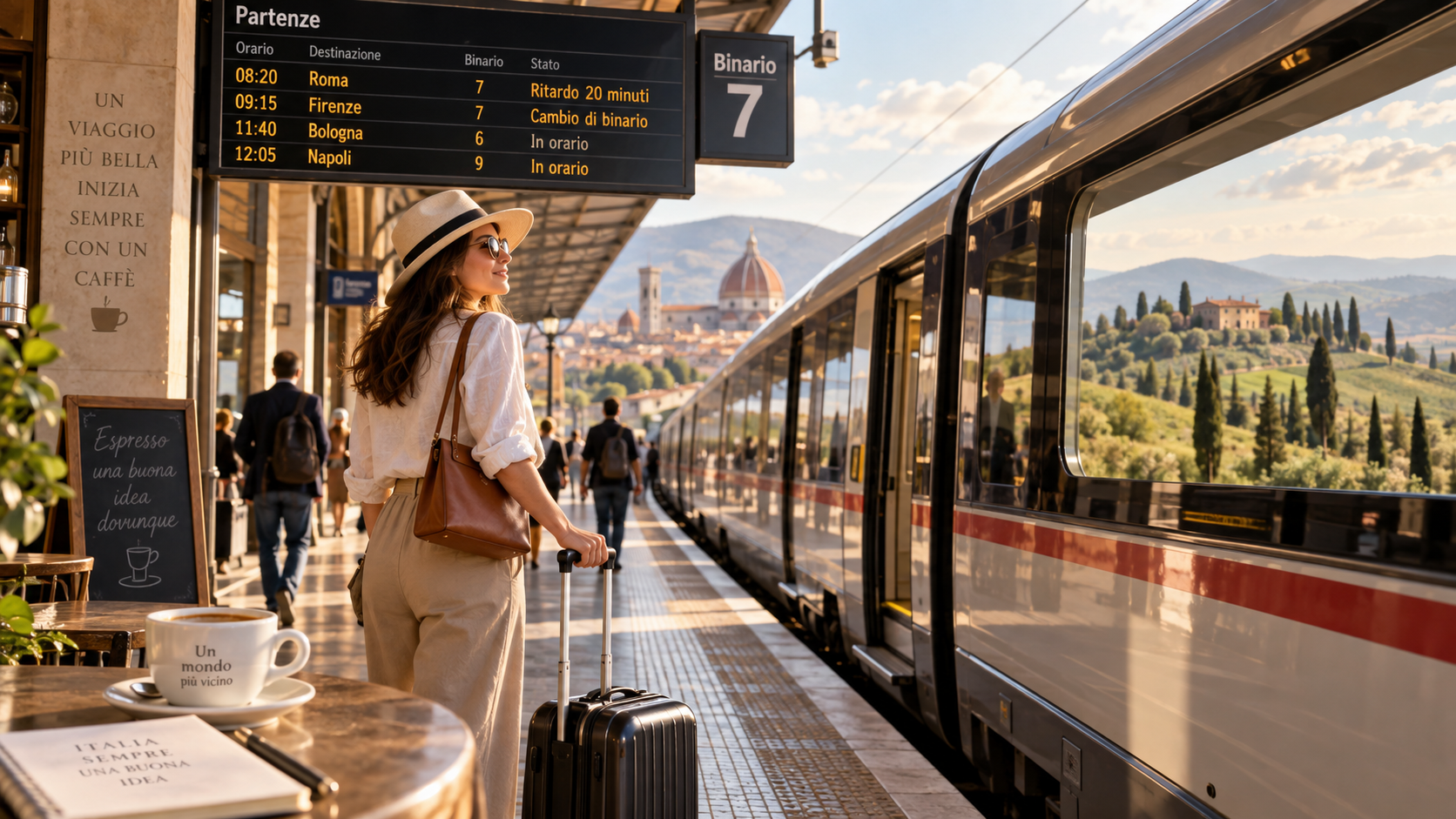
There is something rather satisfying about travelling through Italy by train.
One moment you're drinking coffee in Rome.
A little later, you're looking out of the window at the Tuscan countryside.
And before you've had enough time to seriously consider another espresso, you could be walking through the streets of Florence.
For many visitors, travelling by train is one of the easiest — and most enjoyable — ways to see Italy.
You just need to know a few things before you go.
Why Travel Around Italy by Train?
Italy's rail network connects many of the country's most popular cities, making it possible to see several very different parts of Italy without renting a car.
High-speed trains connect major destinations, while regional services can take you to smaller towns and places further away from the main tourist routes.
Some particularly popular journeys include:
Rome → Florence
One of the easiest combinations for a first trip to Italy.
Spend a few days exploring Rome, then head north to Florence for Renaissance architecture, museums, Tuscan food and perhaps considerably too much gelato.
Rome → Naples
A perfect option if you want to combine Rome with southern Italy.
Naples also makes a useful starting point for visiting places such as Pompeii and the surrounding region.
Florence → Bologna
Two wonderful Italian food cities connected by a very easy train journey.
This could potentially be dangerous.
Particularly if your holiday already involves pasta, wine and very little self-control.
Milan → Venice
Northern Italy can be remarkably easy to explore by rail.
You can leave one of Italy's most modern cities and find yourself surrounded by canals, bridges and narrow Venetian streets a few hours later.
And then there are regional trains, which can take you beyond the major cities into smaller destinations throughout the country.
Sometimes those journeys become some of the most memorable parts of the trip.
Buying Your Ticket
Today, many travellers buy their tickets online or through an app.
But you may still find yourself speaking to someone at a station — especially if you're unsure which train to take or need some help.
One very useful phrase is:
Vorrei un biglietto per Firenze, per favore.
I'd like a ticket to Florence, please.
If you're travelling somewhere else, simply replace Firenze with your destination.
You may then hear:
Solo andata o andata e ritorno?
One way or return?
For a one-way ticket:
Solo andata, per favore.
One way, please.
You can also ask:
Quanto dura il viaggio?
How long does the journey take?
Or:
Devo cambiare treno?
Do I have to change trains?
If you're lucky, the answer will be:
No, è diretto.
No, it's direct.
Always nice to hear.
Know Which Train You're Taking
Italian stations can be busy.
Particularly in larger cities such as Rome, Milan, Florence and Naples.
So give yourself enough time to find your departure information and locate the correct platform.
The Italian word you'll want to look for is:
binario
You can ask:
Da quale binario parte il treno?
Which platform does the train leave from?
You might hear:
Il treno parte dal binario sette.
The train leaves from platform seven.
But don't assume the platform will necessarily stay the same.
Which brings us to one of the more interesting parts of train travel.
Watch the Departure Board
Train times and platforms can change.
If you see:
ritardo
it means:
delay
So:
Ritardo di venti minuti
means:
20-minute delay.
You may also hear or see:
cambio di binario
which means:
platform change
This is one of those expressions worth recognising even if you remember nothing else.
Because discovering that your train has moved to another platform is much more useful before the train leaves.
You can ask:
Il binario è sempre il sette?
Is it still platform seven?
Or, if it has changed:
Dove si trova il binario nove?
Where is platform nine?
Then follow the signs.
Preferably quickly.
What About Validating the Ticket?
This can confuse travellers because not every Italian train ticket works in exactly the same way.
Tickets for reserved high-speed and long-distance trains are generally connected to a specific train, departure and seat, so they don't normally require the same type of physical validation used with traditional regional paper tickets.
Regional travel can work differently depending on the type of ticket you have.
So if you're ever unsure, the safest solution is simply to ask:
Devo convalidare il biglietto?
Do I need to validate the ticket?
It's a very useful phrase.
And considerably better than finding out after you've boarded.
Find the Right Carriage
Once you reach the train, you may also need to find your carriage.
The Italian word for carriage is:
carrozza
For example:
Devo trovare la carrozza numero quattro.
I need to find carriage number four.
You'll usually find carriage numbers displayed outside the train and around the doors.
Then find your seat, put away your luggage and enjoy the journey.
At least until someone asks to see your ticket.
A Little Italian Makes the Journey Easier
You certainly don't need fluent Italian to travel around Italy by train.
Thousands of visitors do it every day.
But knowing a few useful phrases can make the experience considerably easier.
You can buy the ticket you want.
Ask how long the journey takes.
Find the correct platform.
Understand that your train is delayed.
Recognise that the platform has changed.
And ask for help without relying entirely on pointing at your phone.
That's exactly why we created our Italian at the Train Station — From Buying a Ticket to Arrival lesson.
It follows one complete train journey from Rome to Florence, including buying a ticket, choosing a seat, finding the platform, dealing with a delay and platform change, boarding the train and finally arriving in Florence.
You can watch the complete lesson free on YouTube.
Because travelling around Italy by train is already part of the experience.
It's even better when you understand what's happening around you.
Free Italian PDFs
Want to take some Italian with you?
We also have FREE Italian PDFs available to download, including practical materials designed for real travel situations.
They can help you review useful phrases before your trip and keep practical Italian close at hand while you're travelling.
———CLICK HERE FOR THE FREE PDFs———
You'll also find free materials covering hotels, restaurants, everyday conversations, useful vocabulary and much more.
You don't need to learn everything before you arrive.
Sometimes a few useful phrases are enough to make Italy feel considerably easier to navigate.