
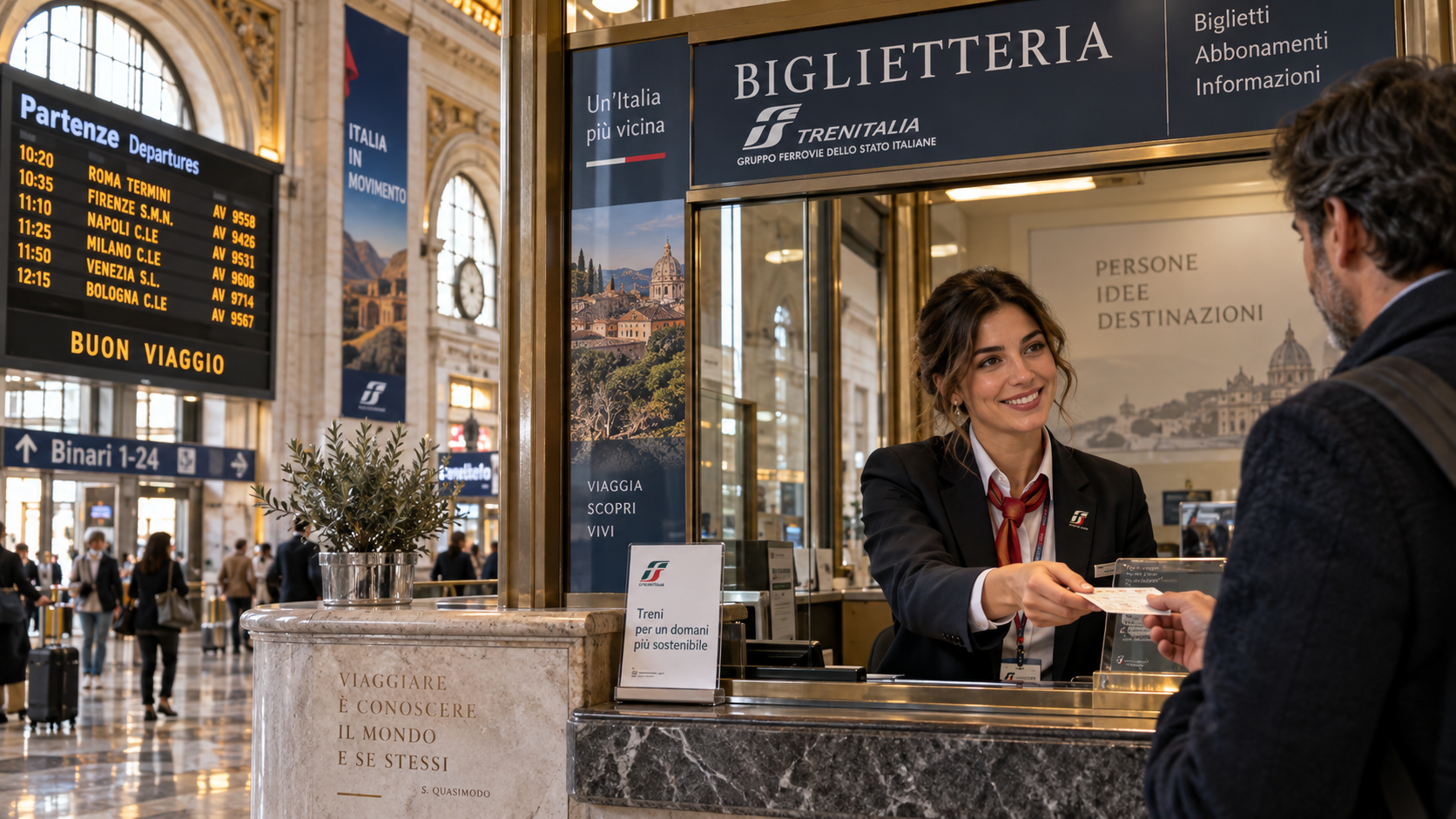
Learning a few Italian phrases before a trip is useful.
But real conversations have an inconvenient habit of continuing after you speak.
You ask a question.
Someone answers.
And suddenly the Italian phrase you memorized perfectly is only half the conversation.
That’s why train stations are such a good place to practice practical Italian.
The situations are predictable.
The language is useful.
And once you understand a few common questions and replies, the entire experience becomes much easier.
Buying a Ticket
Let’s start with one of the most useful phrases:
Vorrei un biglietto per Firenze, per favore.
I’d like a ticket to Florence, please.
Simple enough.
But what might you hear next?
Very possibly:
Solo andata o andata e ritorno?
One way or return?
If you only need a one-way ticket:
Solo andata, per favore.
One way, please.
You may also hear:
Per oggi?
For today?
Or:
A che ora vuole partire?
What time would you like to leave?
This is the part that matters.
You don’t need to understand every word perfectly.
You just need to recognize enough to know what they are asking.
Choosing the Train
Suppose there are several departures.
The ticket clerk may say:
C’è un treno alle dieci e venti e un altro alle undici e cinque.
There’s a train at 10:20 and another at 11:05.
You can ask:
Quanto dura il viaggio?
How long does the journey take?
Or:
Devo cambiare treno?
Do I have to change trains?
And one of the nicest replies you can hear is:
No, è diretto.
No, it’s direct.
Particularly if you are carrying luggage.
Choosing Your Seat
On some trains, you may also be asked where you would like to sit.
For example:
Finestrino o corridoio?
Window or aisle?
If you want the window:
Finestrino, se possibile.
Window, if possible.
You may hear:
C’è un posto disponibile vicino al finestrino.
There’s a seat available by the window.
And then, of course:
Quanto costa il biglietto?
How much is the ticket?
Followed by:
Posso pagare con la carta?
Can I pay by card?
These are small interactions.
But they are exactly the kind of interactions that make travel feel easier.
Finding the Platform
Once you have the ticket, the next question is usually:
Da quale binario parte il treno?
Which platform does the train leave from?
The answer might be:
Il treno parte dal binario sette.
The train leaves from platform seven.
And if you didn’t understand:
Mi scusi, non ho capito bene. Può ripetere, per favore?
Excuse me, I didn’t understand very well. Could you repeat, please?
This is one of the most useful phrases you can know in Italian.
Not just at a station.
Anywhere.
When the Platform Changes
Now things become slightly more interesting.
You look at the departure board and discover that your train is no longer leaving from platform seven.
You might ask:
Mi scusi, il tabellone adesso indica il binario nove. È corretto?
Excuse me, the board now shows platform nine. Is that correct?
And you may hear:
Sì. C’è stato un cambio di binario.
Yes. There’s been a platform change.
Another useful phrase is:
Dove si trova il binario nove?
Where is platform nine?
You may then get a longer answer:
Deve scendere le scale, attraversare il sottopassaggio e poi seguire le indicazioni.
You need to go down the stairs, cross the underpass and then follow the signs.
You probably won’t catch every word the first time.
That’s normal.
Listen for the useful pieces:
scale — stairs
sottopassaggio — underpass
indicazioni — signs/directions
Sometimes understanding three words is enough.
When the Train Is Delayed
Another word worth recognizing immediately is:
il ritardo
It means:
delay
So if the board says:
Ritardo di venti minuti
you know your train is delayed by twenty minutes.
You can ask:
Il treno è in ritardo?
Is the train delayed?
And hear:
Sì, purtroppo il treno è in ritardo.
Yes, unfortunately the train is delayed.
You might also hear:
Le consiglio di controllare il tabellone.
I recommend checking the board.
Very useful advice.
Especially if your platform has already changed once.
Finding Your Carriage and Seat
Once you reach the train, you may need to find your carriage.
You can say:
Devo trovare la carrozza numero quattro.
I need to find carriage number four.
Someone might reply:
La carrozza quattro è più avanti.
Carriage four is further ahead.
And once you board, you may discover somebody sitting in your seat.
You can say:
Mi scusi, credo che questo sia il mio posto.
Excuse me, I think this is my seat.
A very possible reply:
Ha ragione. Mi scusi, ho sbagliato posto.
You’re right. Sorry, I’m in the wrong seat.
Crisis avoided.
No dramatic confrontation required.
What You’ll Hear from the Conductor
At some point, the conductor may come through the train and say:
Biglietti, per favore.
Tickets, please.
You can reply:
Certo. Ecco il mio biglietto.
Of course. Here’s my ticket.
You may also hear:
Ha anche un documento d’identità?
Do you also have an ID?
And if you want to ask about your arrival time:
A che ora arriveremo a Firenze?
What time will we arrive in Florence?
You may hear:
Dovremmo arrivare verso mezzogiorno e venti.
We should arrive at around 12:20.
Again, the useful part is not only knowing what to ask.
It’s being ready for the answer.
Approaching Your Stop
As you get close to your destination, you might ask another passenger:
Mi scusi, la prossima fermata è Firenze?
Excuse me, is the next stop Florence?
They may say:
Sì, Firenze Santa Maria Novella.
Yes, Florence Santa Maria Novella.
Then:
Quanto manca?
How much longer?
And perhaps:
Circa dieci minuti.
About ten minutes.
Which gives you just enough time to remember that your suitcase is still above your seat.
This Is the Part Language Apps Often Miss
Many language lessons teach you what to say.
That’s useful.
But in real life, the other person says something back.
Sometimes quickly.
Sometimes unexpectedly.
Sometimes using words you didn’t study.
That’s why practical Italian is not just about memorizing phrases.
It’s about recognizing the replies you are most likely to hear.
If you can understand:
Solo andata o andata e ritorno?
Il treno parte dal binario sette.
C’è stato un cambio di binario.
Biglietti, per favore.
Ha anche un documento d’identità?
you are already much better prepared for the journey.
And that’s exactly what we focus on in our Italian at the Train Station — From Buying a Ticket to Arrival lesson.
It follows one complete trip from Rome to Florence and shows both sides of the conversation.
What you say.
And what you’re likely to hear back.
Watch the Full Train Conversation
You can watch the complete lesson free on YouTube.
It covers buying the ticket, choosing a seat, finding the platform, dealing with delays and platform changes, finding the correct carriage, ticket inspection and finally arriving in Florence.
Because knowing what to say is useful.
But understanding what happens next is what makes the conversation work.
Free Italian PDFs
Want to practice before your trip?
We also have FREE Italian PDFs available to download, including practical travel materials designed to help you review real phrases and common responses.
———CLICK HERE FOR THE FREE PDFs———
You’ll also find free Italian materials covering hotels, restaurants, everyday conversations, useful vocabulary and much more.
You don’t need perfect Italian to travel around Italy.
You just need enough to understand what’s happening.
And enough to know what to say next.