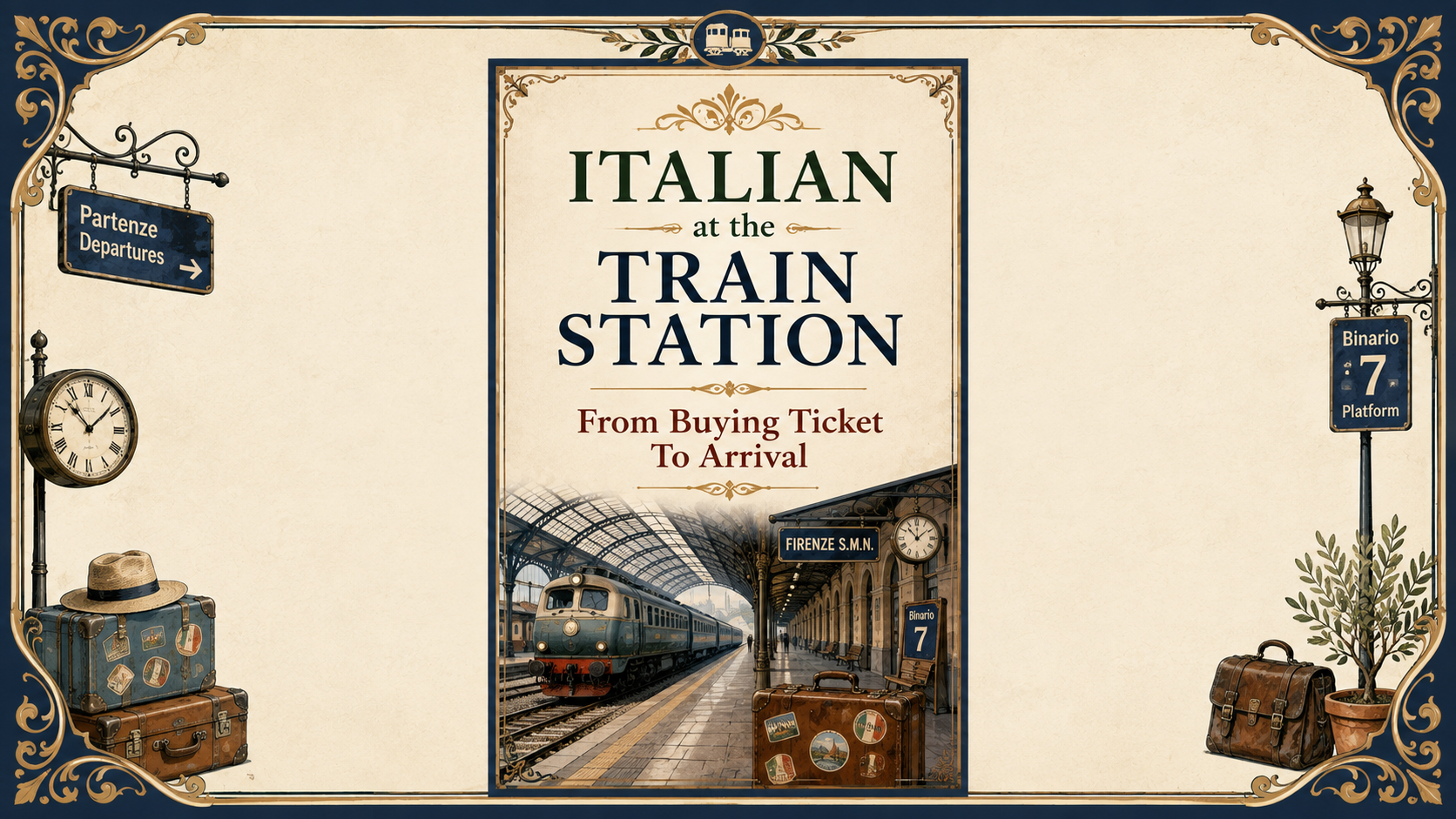

Knowing what to say at an Italian train station is only half the conversation. Learn useful phrases for tickets, platforms, delays, seats and arrivals — plus the replies you’re most likely to hear back.

ITALIAN IN REAL LIFE
You’ve learned some Italian. You know how to ask for a ticket and recognize a few travel words.
Then you arrive at an Italian train station — announcements are playing, departure boards are changing, and someone behind the counter starts speaking Italian.
This complete lesson takes you through a realistic train journey in Italy, helping you understand what you may actually hear and know what to say back.
In this lesson, you’ll follow a complete train journey through eight practical conversations:
Part 1 — Buying the Ticket
Part 2 — Choosing the Seat and Paying
Part 3 — Finding the Platform
Part 4 — The Train Is Delayed
Part 5 — The Platform Changes
Part 6 — Finding the Carriage and Seat
Part 7 — Ticket Inspection
Part 8 — Arriving
You’ll learn how to buy a train ticket, choose your seat, ask where your train leaves from, understand delays and platform changes, find your carriage and seat, speak with the conductor and know what to say when you arrive at your destination.
More importantly, you’ll hear these phrases as part of realistic conversations — so you can practise understanding what someone might actually say to you.
Learning how to ask a question is only half the conversation.
Imagine you’re standing at the station and hear:
Il treno ha un ritardo di venti minuti.
The train is twenty minutes late.
Or suddenly:
Il binario è cambiato.
The platform has changed.
You need to understand what was said — and know what to do next.
That’s the gap Proficiency Consultant is designed to bridge.
We focus on real phrases, realistic conversations and the Italian you’re likely to hear when travelling in Italy — so the language feels familiar when you actually need it.
Want to practise these conversations yourself?
Visit the Proficiency Consultant Italian Library for downloadable learning materials, including FREE PDFs from the Italian Train Travel series and many more practical Italian lessons.
Use the PDFs alongside the video to review the conversations, practise the phrases and prepare before your next journey through Italy.
Learn the Italian you’ll actually need.
Understand what Italians may actually say.
Know what to say when the conversation suddenly becomes real.
In this lesson you'll learn how to ask which platform your train leaves from in Italian. This is one of the most useful phrases to know when travelling through Italy by train, especially in busy stations like Milano Centrale, Roma Termini, or Firenze Santa Maria Novella.
Whether you're visiting Italy for the first time or simply want to travel with more confidence, this practical phrase will help you communicate naturally with station staff and find your train quickly.
Italian Phrase:
Da quale binario parte il treno per Milano?
English:
Which platform does the train to Milan leave from?
Traveling by train in Italy?
Learn how to ask “Questo treno va a Firenze?”, meaning “Does this train go to Florence?”
This practical Italian phrase uses questo treno (this train), va a (goes to), and Firenze (Florence). A simple and useful question for checking your train destination while traveling in Italy.
You need a taxi in Italy and want to show the driver where to go.
One simple phrase can make the conversation much easier:
“Mi porti a questo indirizzo?”
Can you take me to this address?
This phrase is especially useful when you have the destination saved on your phone or written down.
Learn practical Italian for travel, transportation, and real-life situations in Italy.
In this beginner-friendly Italian lesson, you’ll learn essential Italian pronunciation basics along with useful everyday phrases for introducing yourself, asking questions, and having simple conversations in Italian.
Italian pronunciation is known for being clear, musical, and consistent. Learning proper pronunciation early can greatly improve your confidence, listening skills, and speaking ability.
This lesson is perfect for beginners starting their Italian language journey.
Mi chiamo [your name]. — My name is [your name].
Sono [your name]. — I am [your name].
Come ti chiami? — What’s your name? (informal)
Come si chiama? — What’s your name? (formal)
Come stai? — How are you? (informal)
Come sta? — How are you? (formal)
Sto bene. — I am well.
Sto bene, grazie. E tu? — I’m well, thank you. And you? (informal)
Sto bene, grazie. E Lei? — I’m well, thank you. And you? (formal)
Grazie — Thank you
Prego — You’re welcome
Per favore — Please
Scusa / Mi scusi — Excuse me
Mi dispiace — I’m sorry
A presto! — See you soon!
A great beginner lesson for travelers, students, and anyone who wants to start speaking Italian confidently.
Welcome to this beginner-friendly Italian pronunciation lesson from Proficiency Consultant’s Italian Language Series. In this introduction, you’ll begin learning how Italian sounds are pronounced, how words naturally flow in conversation, and how to build confidence speaking Italian clearly and naturally.
Italian is often considered one of the most beautiful and musical languages in the world. The pronunciation system is also very consistent, making it an excellent language for beginners.
This lesson is designed to help you develop a strong foundation in:
Italian pronunciation
listening comprehension
speaking confidence
conversational flow
everyday communication
In this lesson, you’ll begin to understand:
how Italian vowels are pronounced
common Italian sound patterns
pronunciation rhythm and stress
how Italian words flow together naturally
beginner-friendly conversational pronunciation
Learning pronunciation early helps you:
sound more natural when speaking
understand native speakers more easily
improve your listening skills
communicate with greater confidence
build a stronger foundation for fluency
Italian pronunciation is highly phonetic, meaning words are usually pronounced exactly as they are written. This makes Italian one of the most approachable languages for beginners.
This lesson is ideal for:
complete beginners
travelers preparing for Italy
conversational Italian learners
students improving pronunciation
anyone starting their Italian language journey
A strong pronunciation foundation can dramatically improve your ability to speak and understand Italian in real-world situations.