
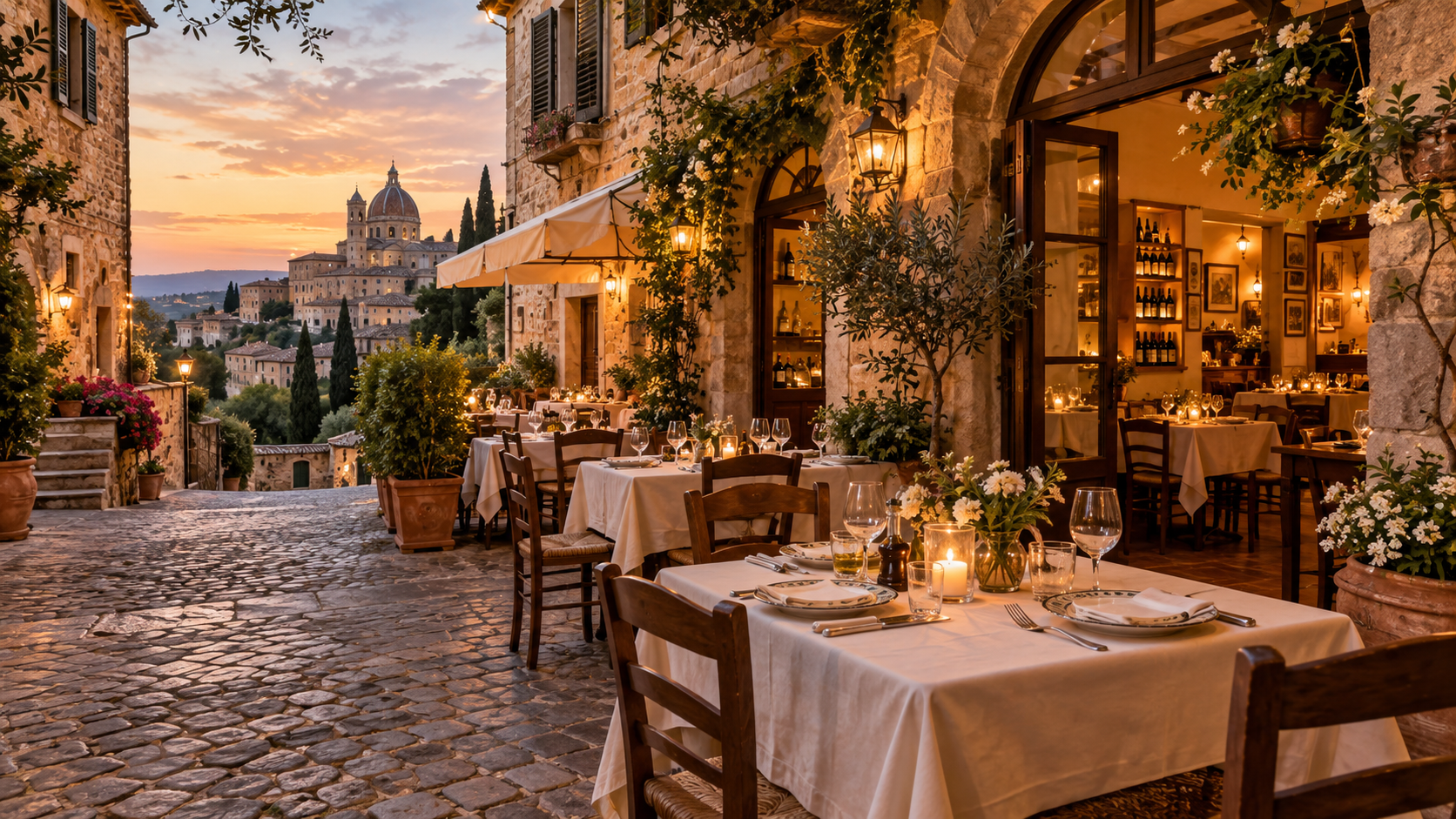
Eating in Italy sounds simple enough.
Find a restaurant.
Order pasta.
Drink wine.
Go home happy.
And sometimes, it really is that easy.
But Italian restaurants also have a few customs that can surprise visitors — especially if you're used to dining in the United States, the UK or elsewhere.
Nothing terribly complicated.
Just enough small differences to make you wonder whether you're supposed to ask for the bill, tip twenty percent, order a cappuccino after dinner or worry about that mysterious charge called coperto.
So before your next meal in Italy, here are a few things worth knowing.
The Bill Usually Won’t Arrive Until You Ask for It
In many Italian restaurants, the waiter won’t automatically bring the bill the moment you finish eating.
That’s not bad service.
It’s usually the opposite.
Italian dining tends to be less rushed, and unless the restaurant needs the table back, you can often sit, talk and finish your wine without feeling pushed out. (The Local Italy)
When you're ready, simply ask:
Possiamo avere il conto, per favore?
Could we have the bill, please?
You may hear:
Certamente. Ve lo porto subito.
Certainly. I’ll bring it right away.
Very simple.
And much better than sitting there for twenty minutes wondering whether the waiter has forgotten you.
You May See a Charge Called Coperto
This is one that catches many visitors by surprise.
In much of Italy, restaurants may add a coperto — a fixed per-person cover charge for sitting at the table.
It is usually listed on the menu and may be a few euros per person, although it can be more expensive in major tourist locations. (The Local Italy)
You may also see charges such as:
pane — bread
servizio — service
These should be clearly disclosed on the menu or price list. (Walks of Italy)
One important exception is Lazio, the region that includes Rome, where a traditional coperto charge is prohibited by regional law. (The Local Italy)
So if you see an unfamiliar charge on the bill, don’t immediately assume something is wrong.
Just check what was listed on the menu.
Tipping Is Different
This is particularly important for American visitors.
You generally do not need to tip 15, 20 or 25 percent in an Italian restaurant.
Tipping is not compulsory, and Italian restaurant workers do not rely on tips in the same way many servers do in the United States. (Italia.it)
If you had excellent service, you can leave something extra.
Often people simply round up the bill or leave a few euros.
And if a service charge is already included, there is even less reason to add a large gratuity. (Walks of Italy)
So if your bill is €83, you do not need to begin performing emergency mathematics under the table.
Relax.
You’re in Italy.
The Menu May Be Structured Differently Than You Expect
A traditional Italian menu often separates the meal into courses.
You might see:
Antipasti
Starters.
Primi
First courses — often pasta, risotto or soup.
Secondi
Main protein dishes such as meat or fish.
Contorni
Side dishes.
Dolci
Desserts.
That does not mean you have to order every course.
Most people do not sit down and mechanically order one item from each section.
You can order what you want.
But understanding the structure makes the menu much easier to read.
For example:
Come antipasto, vorremmo una bruschetta da dividere.
As a starter, we’d like a bruschetta to share.
Then:
Per me le pappardelle al ragù di cinghiale.
For me, the pappardelle with wild boar ragù.
And perhaps:
Desiderate anche un contorno?
Would you also like a side dish?
Now the menu starts to make a little more sense.
Water Is Usually a Question
Ask for water and you may immediately hear:
Naturale o frizzante?
Still or sparkling?
This is extremely common.
So if you want still water:
Naturale, grazie.
For sparkling:
Frizzante, grazie.
Not the most difficult Italian you’ll ever learn.
But possibly some of the most useful.
You Can Ask the Waiter What They Recommend
You do not have to understand every dish on an Italian menu.
In fact, sometimes asking is half the fun.
You can say:
Che cos’è la tagliata di manzo?
What is the tagliata di manzo?
Or:
Che cosa mi consiglia come primo piatto?
What do you recommend as a first course?
You may hear:
Le consiglio le pappardelle al ragù di cinghiale.
I recommend the pappardelle with wild boar ragù.
Or:
È una specialità della casa.
It’s a house speciality.
That kind of conversation can often lead to a much better meal than choosing the one dish whose name you recognize.
You Don’t Have to Pretend Everything Is Fine
If something is wrong with the order, you can say so politely.
For example:
Credo che ci sia un piccolo problema.
I think there’s a small problem.
Then explain what happened.
If the waiter realizes the mistake, you may hear:
Ha ragione. Le chiedo scusa. È un mio errore.
You’re right. I apologize. It’s my mistake.
Which is considerably better than silently eating the wrong side dish and resenting it for the next three hours.
Food Allergies Need to Be Taken Seriously
If you or someone you're dining with has an allergy, say it clearly.
For example:
Il mio compagno è allergico alle noci.
My companion is allergic to nuts.
And you can ask:
Ci sono noci in questo piatto?
Are there nuts in this dish?
A careful waiter may say:
Preferisco controllare con il cuoco.
I’d prefer to check with the chef.
That is exactly the kind of answer you want to hear.
For serious allergies, it is also wise to explain the issue clearly before ordering and confirm possible cross-contact.
Coffee After Dinner Is Not Quite the Same as Coffee at Home
Italy has its own coffee culture.
An espresso after a meal is completely normal.
A cappuccino after dinner is much less traditionally Italian.
That does not mean someone will throw you out of the restaurant if you order one.
You can order what you like.
But if you want to follow local habits more closely, an espresso after the meal is the more typical choice.
You might say:
Per me un espresso.
An espresso for me.
Simple.
Elegant.
And considerably smaller than the coffee you may be used to.
Eating in Italy Is Meant to Be Enjoyed
Perhaps the most useful thing to understand is that dinner in Italy is not always treated as something to get through quickly.
You are there to eat.
Talk.
Have some wine.
Ask questions.
Maybe share dessert.
Possibly order coffee.
And eventually ask for the bill when you’re ready.
That slower rhythm is part of the experience.
Knowing a little Italian simply makes it easier to enjoy.
And that’s exactly what we cover in our Italian at the Restaurant — From Arriving to Paying the Bill lesson.
It follows the complete restaurant experience — arriving with a reservation, choosing a table, ordering drinks, understanding the menu, asking for recommendations, dealing with allergies and mistakes, ordering dessert and finally paying the bill.
Watch the Complete Restaurant Conversation
You can watch the full Italian at the Restaurant — From Arriving to Paying the Bill lesson free on YouTube.
[YOUTUBE VIDEO EMBED HERE]
Because ordering food in Italy is one thing.
Knowing what happens around the meal makes the experience considerably easier.
And usually much more enjoyable.
Free Italian PDFs
Want to take some practical Italian with you?
We also have FREE Italian PDFs available to download, including materials designed for restaurants, hotels, travel and everyday conversations.
———CLICK HERE FOR THE FREE PDFs———
You do not need perfect Italian to enjoy a restaurant in Italy.
But knowing how to ask for the bill, understand the menu, order a drink and recognize a few common replies can make the entire evening feel much more natural.